


Discover how Google’s AI Overviews are reshaping visibility in search. LangSync’s latest study reveals whether small websites are losing ground to high-authority domains in the new AI-driven SERP.
TL;DR
- Google’s AI Overviews were expected to make search fairer, but the data shows they often strengthen existing authority instead.
- Low-domain authority (DA ≤ 30) sites are about half as likely to appear in top search results when AI Overviews are present.
- The average DA of top-ranked sites rises from around 75 to nearly 79 when AI Overviews show up.
- Transactional and commercial searches show the strongest bias towards big, established domains.
Search is changing fast. The familiar list of blue links has been replaced by a new layer of AI summaries, where Google doesn’t just show results, it explains them.
This subtle shift has completely rewritten the rules of visibility.
When AI Overviews were first introduced, many people thought they would help smaller publishers finally break through. The logic seemed simple enough: if AI could understand context and content quality, it might surface niche expertise alongside big brands.
The team at LangSync AI, an AEO agency, however, found something different.
After studying 2,000 Google searches across different types of intent, the data showed that AI Overviews do not close authority gaps. In fact, they make them wider.
Our analysis suggests that when AI Overviews appear, search results lean even more towards high-domain authority websites that already dominate. It is a reminder that in this new search era, visibility is not just about being relevant anymore. It is about being trusted, structured, and consistent.
Why This Conversation Matters
Visibility in search is no longer about who gets the click.
AI Overviews have changed the game. Instead of ten blue links on the search engine result page (SERP), we now have snapshots, summaries, and direct answers that show up before people ever reach a website.
In this new setup, the rules of visibility have shifted.
Authority has become the real currency. When AI generates an answer, it relies on information it considers stable, consistent, and widely trusted. The challenge is that those signals usually come from big, established domains. Strategic brand identity services can help a business present consistent, verifiable signals across digital platforms, thereby strengthening the external trust markers that AI models look for when evaluating authority.
That is what makes this conversation important. Many people expected generative search to make things fairer by rewarding quality content over brand reputation.
Yet the data from LangSync’s research shows something else entirely. The new AI-driven layer often amplifies sites that already hold authority instead of lifting smaller ones into view.
This leaves marketers and creators with two big questions.
Is AI reducing the power of authority or making it even stronger? And for smaller websites, how can they compete in a system where trust and consistency are now the deciding factors?
Study Design and Methodology
To explore this, the research team at LangSync analysed 2,000 Google searches covering informational, commercial, and transactional intents. Each keyword was randomly selected from difficulty levels between 0 and 80, ensuring a balanced mix of easy and competitive searches.
For each query, the team recorded:
- Keyword difficulty
- Search intent
- The top three domains that ranked on Google
- The domain authority (DA) and age of each domain
- The presence or absence of an AI Overview
- Other visible features such as paragraph snippets, lists, videos, images, tables, and rich results
Low authority was defined as any site with a DA of 30 or below. The goal was simple: to see whether AI Overviews presence is helping or hurting the visibility of smaller, low-authority domains.
The dataset focused on English-language queries collected in September 2025.
The sampling method was randomised across difficulty levels to make sure both long-tail and high-volume queries were represented fairly.
Key Findings
Here are what we found.
Fewer Low-Authority Sites When AI Overviews Are Present
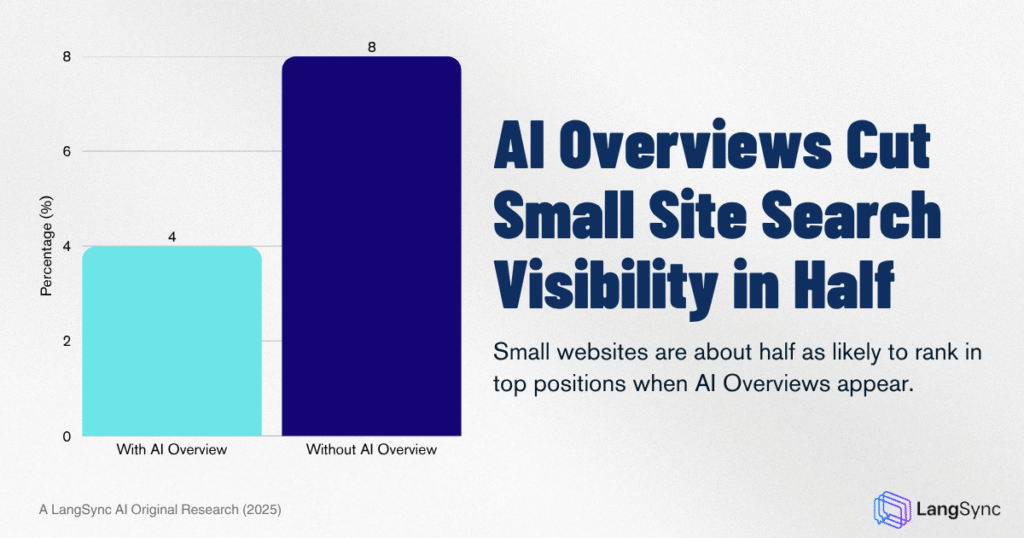
When AI Overviews appeared, only about 4 percent of first-position domains had a DA of 30 or lower.
Without AI Overviews, that number nearly doubled to 8 percent. Smaller sites were roughly half as likely to appear in top positions when an AI Overview was present.
Key Takeaway: Small websites are about half as likely to rank in top positions when AI Overviews appear, showing that generative results favour higher-authority domains.
High-Authority Domains Dominate AI Overview Results
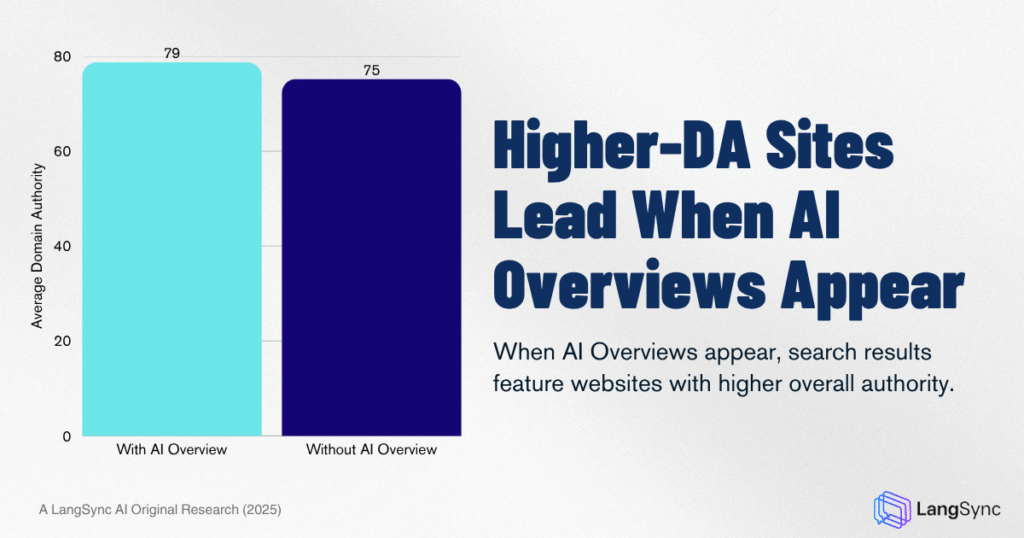
Across all 2,000 searches, the average DA of top-ranked domains was 78.7 when AI Overviews were present and 75.2 when they were not.
The difference may look small, but it was consistent. It shows that Google’s AI layer continues to lean towards sites that already project strong authority and credibility.
Key Takeaway: When AI Overviews appear, search results feature websites with higher overall authority, reinforcing the influence of authority.
Authority Gap by Intent Type
Search intent also played a role. Informational queries showed the smallest authority gap, while transactional searches showed the largest.
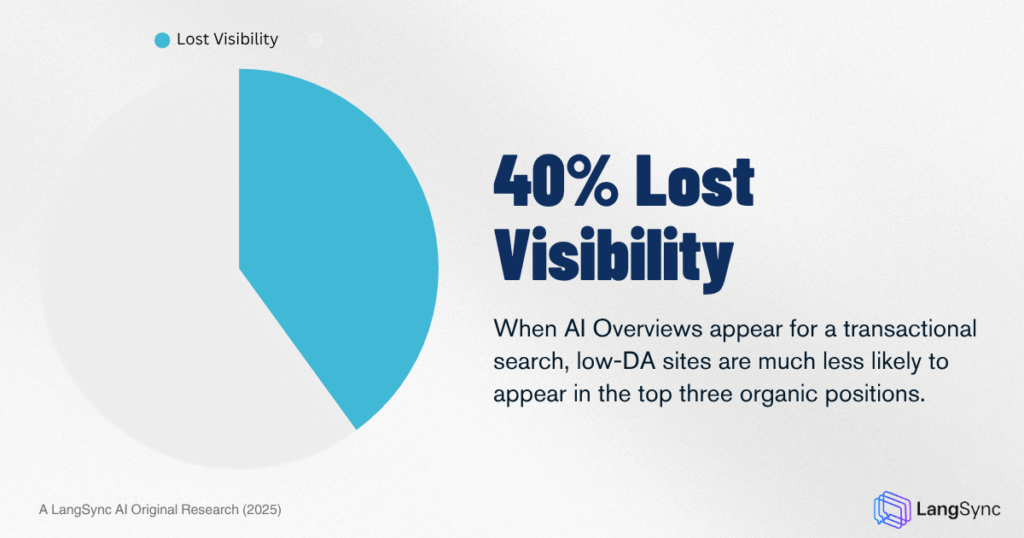
For transactional queries, low-domain authority sites lost almost 40% of their top-three visibility when AI Overviews appeared. That means when AI Overviews appear for a transactional search, smaller sites (low DA) are much less likely to appear in the top three organic positions.
For commercial queries, the pattern is similar though slightly less extreme.
For informational searches, the difference is smaller. AI Overviews still prefer well-known sources, but smaller, niche or educational sites occasionally hold their ground.
Together, these patterns suggest that the more commercially valuable a search is, the stronger Google’s preference for high-authority domains becomes.
Key Takeaway: When money or transactions are involved and AI Overviews is present, Google search rely even more heavily on trusted, established websites.
Why It’s Happening
AI Overviews are not designed to highlight new voices.
They are designed to summarise consensus and reflect trusted information. To do that effectively, Google’s AI model prioritises stability over novelty.
The underlying systems reward:
- Consistent claims that appear across multiple sources
- Clear and structured data formats
- Entities that are easy to identify and verify
- Sources that have longevity and reliable backlinks
You can think of it like this: AI listens for the loudest and clearest voices in the room, the ones that are most frequently cited and least likely to contradict each other. This is closely aligned with Google’s focus on experience, expertise, authoritativeness, and trustworthiness, also known as E-E-A-T.
In short, AI Overviews don’t just look for accurate content. They look for content that appears to come from stable, established, and well-referenced domains.
What this Means for Marketers and Content Teams
For Smaller or Low-DA Sites
Focus on originality and specificity. Publish firsthand research, user stories, or data that only you can provide. Use structured formats such as FAQs, how-to guides, and tables that AI can easily parse. Build strong topic clusters and internal links so your expertise is clear across multiple pages.
For Established or High-DA Brands
Maintain consistency across all your content. Keep brand entities, names, and references uniform across the web. Update cornerstone content regularly so Google’s AI models continue to trust your freshness and accuracy.
For Everyone
Target the areas where AI Overviews are weaker. Timely news, evolving trends, and opinion-based content offer more room for smaller sites to shine. Focus on being included in AI-generated summaries, not just on ranking high. In this era, visibility means being referenced, not necessarily clicked.
From SEO to AEO: The Shift from Search to Answers
This shift introduces a new way of thinking called Answer Engine Optimisation (AEO). It focuses on creating content that is clear, structured, and easy for generative systems to understand and include. AEO is not about chasing rankings anymore, it is about becoming part of the answers themselves.
Where SEO measures position, AEO measures inclusion. The new metric is visibility beyond the click, being referenced, cited, or featured inside AI-generated summaries.
This is where LangSync AI leads. The team helps businesses design visibility strategies built for the age of generative search, combining deep research, real-time data, and proprietary analysis to understand how brands can surface inside AI answers across Google, Perplexity, Bing Copilot, and others.
Whether the goal is to strengthen authority signals, structure data for generative engines, or increase inclusion in AI Overviews, LangSync AI gives brands the playbook to dominate the new AI search era.
Final Thoughts: The Road Ahead for AI Visibility
AI Overviews are not democratising search visibility yet. They are amplifying the already trusted and already established. But that does not mean smaller sites cannot rise.
The winners will be the ones who combine human-friendly content, machine-friendly structure, and a commitment to building authority in a way that models cannot ignore.
Visibility in this new world belongs to the brands that publish clear signals, original insight, and content designed for both readers and retrieval systems.