


Every day, people make nearly 16 billion searches on Google looking for answers. Google responds by choosing the snippet format it believes will serve each need best.
The research team at LangSync AI, an AEO agency, analysed a broad dataset of keywords across multiple search intents to understand how often different snippet types appear and what this reveals about how Google interprets user intent.
If you want to future-proof your visibility in a search landscape shaped by AI and shifting snippet behaviour, the insights that follow will show you where to focus next.
Methodology: How We Conducted the Study
To understand how Google aligns snippet types with search intent, we built a dataset of keywords spanning a wide mix of industries and topics.
Each keyword was enriched with two inputs: a difficulty score sourced from SEOquake, and a search intent category assigned using an AI-driven intent classifier.
We then manually queried each keyword on the Google search engine to record which snippet types appeared. The dataset tracked six snippet formats:
- AI Overview
- Paragraph snippet
- List snippet
- Video snippet
- Image snippet
- Table snippet.
After cleaning and standardising the intent labels generated by the classifier, we worked with four intent groups: informational, commercial, transactional and navigational.
We measured the percentage of SERPs showing each snippet type.
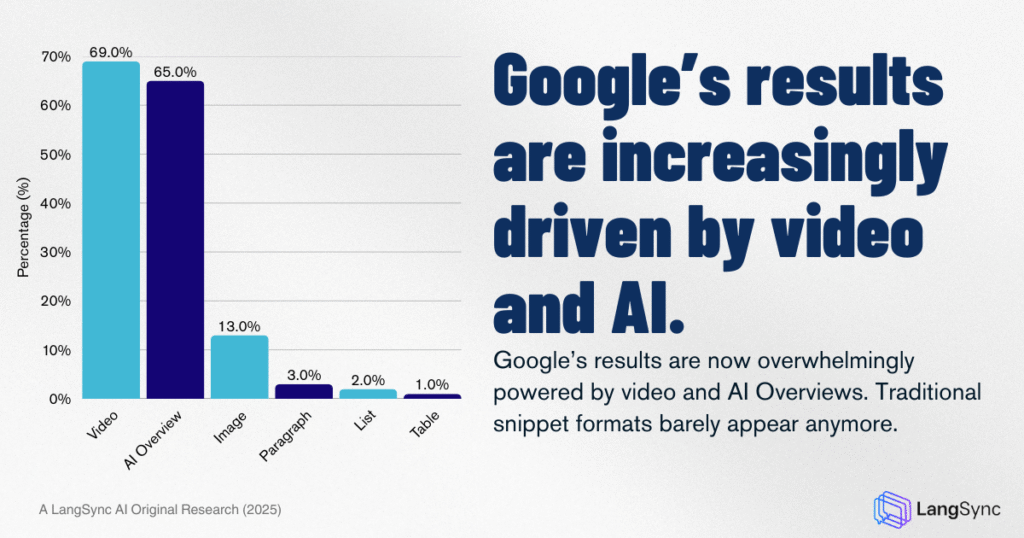
AI Overviews appeared on roughly 65% of searches. Video snippets were even more common, surfacing on around 69% of SERPs. Image snippets appeared on about 13%, while paragraph, list and table snippets showed up only in the low single digits.
We also assessed how snippets stack. Around 27% of SERPs showed no snippet at all. Most displayed exactly one snippet type, at around 61%. Two snippet types appeared together on roughly 12% of SERPs, and only a very small fraction displayed three snippet types at once.
The mix of AI-driven intent tagging, SEOquake difficulty data and manual SERP review provides a clear picture of how Google selects snippet formats based on user intent.
Recommended for You: How to Get Your Brand Noticed by ChatGPT and Google AI
How snippet types vary by search intent
Google tailors each snippet type to the user’s underlying intent, and here we examine how those patterns shift across informational, commercial, and transactional queries.
Informational queries: AI plus video as the default
For informational intent, snippet coverage is very high.
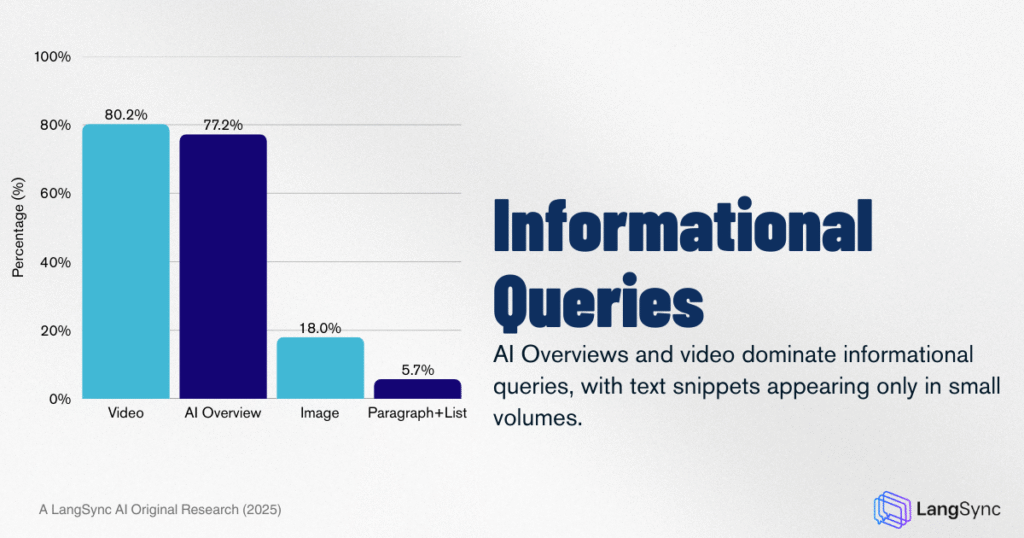
- Video snippet on 80.2% of informational queries
- AI Overview on 77.2%
- Image snippet on 18.0%
- Paragraph and list snippets together on around 5.7% of queries
This paints a clear picture:
- Informational queries rarely get a bare list of links.
- Instead, users get a stacked answer experience: AI Overview at the top, a row of videos, and often supporting images.
From a strategy perspective:
- If you are not producing video content that answers your core informational queries, you are opting out of the most visible real estate.
- If your content is not structured clearly enough to be trusted by the AI Overview, you are also missing the summarisation layer that now frames the whole SERP.
Commercial queries: video-heavy, more cautious with AI
Commercial queries in our study look different.
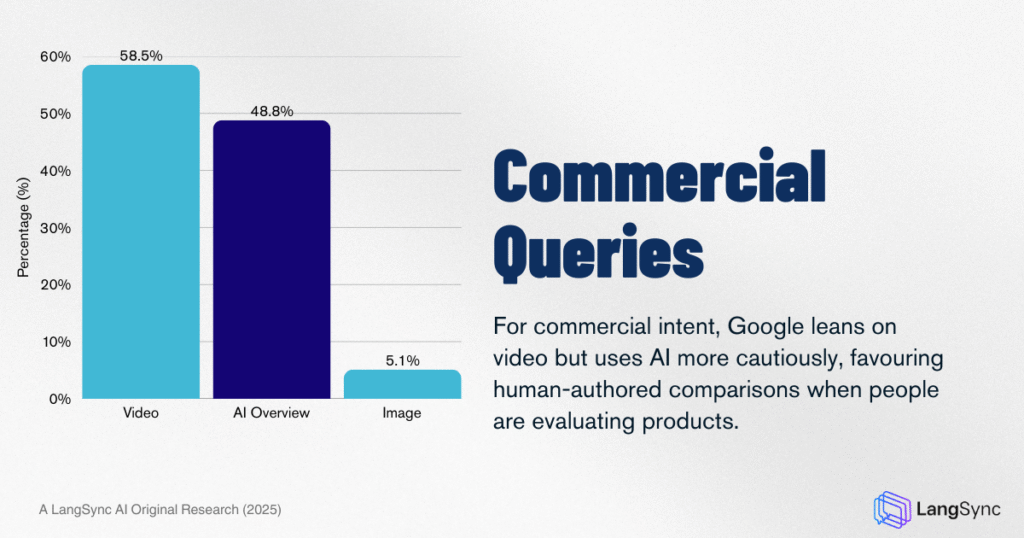
- Video snippet on 58.5% of commercial keywords
- AI Overview on 48.8%
- Image snippet on 5.1%
Compared to informational:
- Video is still common, but AI Overview usage drops by nearly 30 percentage points.
- Image snippets remain modest. Shopping units, prices and brand units, which you will see in the wild, are not captured as a specific column in this study, so the visual emphasis is under-reported.
Reading between the lines:
- Google is more cautious about letting AI summarise commercial intent.
- It still promotes video as a safe, engaging format to compare options and see products in context.
- Traditional paragraph and list snippets hardly feature here either.
For brands, this means:
- Optimising product and category pages just for paragraph snippets is increasingly outdated.
- You should be designing commercial explainer and comparison videos, then backing those up with structured content that the AI Overview can summarise when Google chooses to show it.
Transactional queries: mostly left to classic SERPs
Transactional keywords (for example, phrases with clear buying signals like price or buy) showed:
- Video snippet on only 18.4% of queries
- AI Overview on 28.9%
- Image and other snippets on low single digits
- A very high no snippet rate: 76.5% of transactional queries had zero paragraph, list, video, image or table snippet flags in this dataset
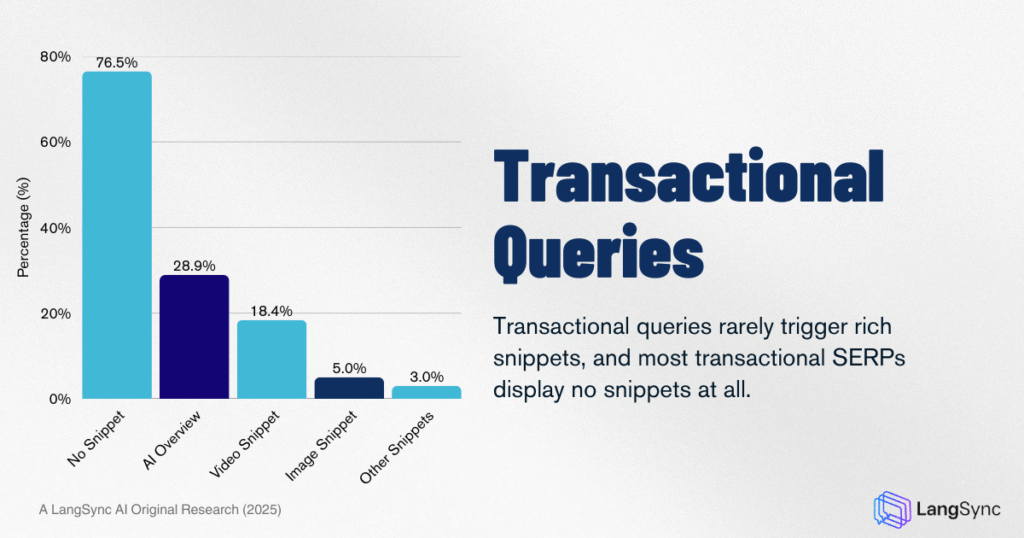
So when the user intent is clearly to transact, Google pulls back from rich snippets and AI summaries, and leans more on:
- Ads
- Shopping units
- Local packs
- Traditional organic listings
In other words, Google seems much less keen to “take responsibility” for the answer when money is about to move.
That has two key implications:
- For transactional pages, do not expect a snippet-led strategy to carry your performance. You are competing through classic ranking factors, ads and feeds.
- The real leverage is to win the upstream informational and commercial queries that feed into those transactional moments.
Question shape and snippet behaviour
We also tagged keywords by their wording:
- Question queries: starting with how, what, why, when, where, who, which
- “Best” queries: starting with “best”
- Local queries: including “near me”
- Buy queries: containing buy, price, cost, cheap and similar phrases
Here is what we found:
Questions supercharge both video and AI Overviews
Around 28% of the keywords in our study were phrased as questions (keywords were randomly generated. Compared to non-question queries, they showed:
- Video snippet on 88.8% of question queries, versus 61.4 % of non-questions
- AI Overview on 75.6% of question queries, versus 60.3% of non-questions
- List snippets also appeared more often on questions, but still at low absolute levels
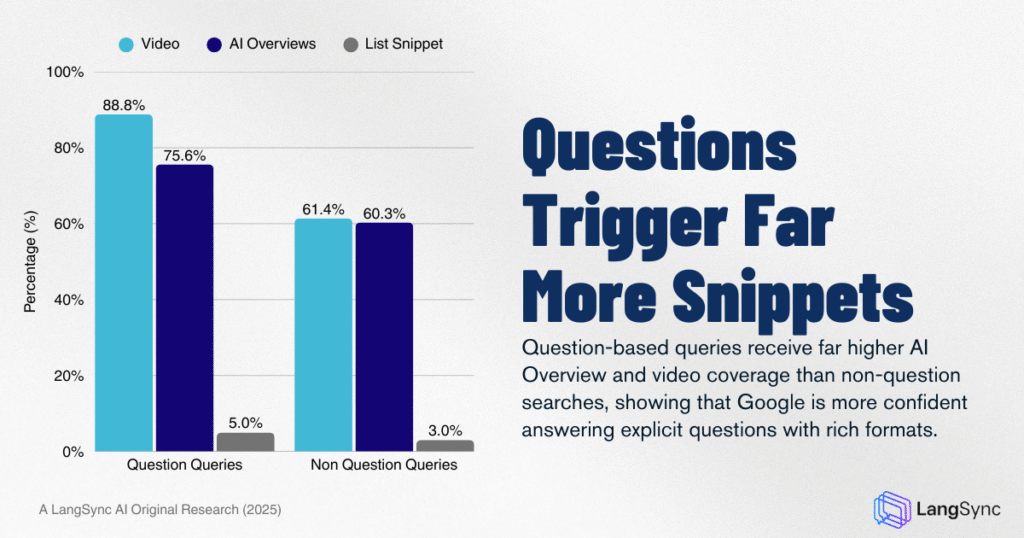
So if you ask Google a question, you are very likely to get:
- An AI Overview summarising the answer
- A video carousel showing you how to do it, how it works or what it means
This is a strong signal for brands:
- If you want to generate question-driven demand (for example, how does X work, what is Y, why Z happens), you should be creating both clear, structured explanations and video content that can sit in that carousel.
“Best” queries do not guarantee lists
“Best” queries are classically associated with list snippets, but in our data, they did not overwhelmingly trigger them.
Compared to other queries:
- List snippets remained rare for “best” terms
- Video snippets were very common for both “best” and non “best” queries
- AI Overview actually appeared less often on “best” queries (around half the time) than on other queries
This suggests that for “best X” type searches, Google may be:
- Leaning harder on commercial signals, comparison content and existing authority
- A little more cautious about asserting a single AI summarised the top list
From a content perspective:
- Classic “10 best X” list posts are no longer enough.
- Comparison videos and transparent ranking logic for how you evaluate “best” (criteria, use cases, trade-offs) are more likely to line up with what Google wants to show.
“Near me” and buy focused queries: snippets become rare
“Near me” and buy-focused keywords were a small fraction of the sample, but the pattern was consistent with the transactional analysis:
- “Near me” queries had far lower video and AI Overview presence
- Buy and price-focused terms also saw reduced snippet usage
These intents are more about local packs, maps, pricing and stock than about interpretive or educational snippets.
Does keyword difficulty influence snippet types?
We turned the difficulty scores into three buckets:
- Low: below 60
- Medium: 60 to 79.9
- High: 80 and above
The headline: difficulty appears to have only a modest relationship with snippet types.
Across the buckets:
- Video snippet presence rose from 49.2% (low) to 65.8% (medium) to 73.6% (high)
- AI Overview presence was surprisingly stable, between 61% and 68% across all three buckets
- Paragraph, list, image and table snippets remained in very low single digits in every group
Correlations between difficulty and snippet flags were very weak:
- Difficulty and AI Overview: slightly negative
- Difficulty and video snippet: very small positive relationship
This suggests that:
- Snippet type is driven far more by intent and query shape than by difficulty.
- High difficulty queries are somewhat more likely to feature videos, which may reflect competitive investment in video around high-value topics.
- AI Overviews seem to be controlled more by safety and policy considerations around query type than by the competitive difficulty of the keyword.
How these patterns map to Google’s underlying logic
Putting the numbers together, a simple model of Google’s behaviour emerges.
- When the intent is to learn (informational), Google is comfortable being very opinionated.
- It leads with an AI-generated summary.
- It surrounds that with video explainers.
- It occasionally adds images or other rich results.
- When the intent is to consider options (commercial), Google becomes more cautious.
- It still uses video heavily.
- It uses AI Overviews roughly half the time, but with more guardrails.
- It trusts brands and publishers to present the options, supported by reviews and comparison content.
- When the intent is to act or buy now (transactional or local), Google largely steps back.
- It minimises AI summarisation.
- It focuses on feeds, shopping units, maps, and direct brand listings.
- It leaves more of the decision-making to the user rather than the model.
- When a query is phrased as a question, Google is incentivised to show something that looks like an answer.
- AI Overview plus video is the dominant pairing.
- Lists and paragraphs are now side characters rather than the main act.
From an AI training perspective, the SERP is increasingly a hierarchy of trust:
- AI Overviews and videos are reserved for areas where Google believes it can safely abstract and explain.
- Where money or legal risk is on the line, the SERP becomes more literal and less interpretive.
Practical playbook: how to align your content with snippet behaviour
Here is how a brand or publisher can use these findings.
1. Build an intent-led content map, not a keyword list
For each cluster of keywords, decide whether your true target intent is:
- Informational
- Commercial
- Transactional
- Navigational
Then design your content and format mix around that, rather than trying to chase individual snippet types.
Recommended For You: How Content Marketers Can Build AI-Optimised Content Pipeline
2. For informational intent, lead with the AI Plus video
Your goal is to be:
- Quoted or used as a source within AI Overviews.
- Featured prominently in the video carousel.
That means:
- Create authoritative explainer content that clearly defines, explains and demonstrates the concept.
- Use clean headings, schema and structured data to make your pages easy to parse.
- Produce short and medium-length videos that directly match the question phrasing your audience uses.
- Ensure titles and descriptions reflect the problem, not just the product.
3. For commercial intent, invest in comparison storytelling
Our study suggests Google favours video plus partial AI coverage for commercial queries.
To take advantage:
- Create comparison videos: X vs Y, “best for”, “which is right for you”.
- Be explicit about your evaluation criteria to align with how users think.
- Use supporting visual content on the page, such as tables and charts, even if they rarely surface as table snippets, because they help AI Overviews extract clear, structured information.
- Make sure your product pages link to these assets, so users can move from comparison to conversion smoothly.
4. For transactional intent, focus on fundamentals and feeds
Since snippet types are less of a lever here:
- Prioritise strong product data feeds, pricing accuracy and stock information.
- Optimise local listings, reviews and structured data for local and e-commerce surfaces.
- Aim to win the upstream informational and commercial queries that feed into transactional intent, so your brand is already familiar when the user finally searches “buy X”.
5. Shape queries, do not just respond to them
Because question phrasing massively increases the likelihood of AI Overviews and videos:
- Use your marketing channels to shape how people search, for example, through social campaigns, email and ads that echo “how” and “what” phrasing.
- Build content that directly mirrors those questions.
- Use FAQ blocks, knowledge hubs and “how to” series that can be clipped by both AI Overviews and video snippets.
What this means for AI search and answer engine optimisation
Although this study is about classic Google SERPs, the patterns are highly relevant to AI search and answer engines.
- The same topics that earn AI Overviews and video prominence are likely to be heavily represented in AI training data.
- Informational and commercial content that is well structured, visually rich and frequently surfaced by Google is more likely to influence how AI assistants answer those questions.
- If you ignore video and structured explanation today, you will not only lose SERP visibility, but you will also lose presence in AI-generated answers tomorrow.
In other words, snippet-aware optimisation is no longer a narrow SEO trick. It is part of a broader answer engine strategy.
Closing thoughts: the intent-led future of Google search
Google is shifting from single snippet answers to multi-format answer experiences that reflect intent:
- AI Overviews and videos dominate informational and question-driven searches.
- Commercial queries sit in a middle ground, with strong video presence and more cautious AI use.
- Transactional and local intents remain more conservative, with fewer snippets and more traditional SERP formats.
If you want to stay visible, you should stop asking “how do I win a paragraph snippet for this keyword” and start asking:
“For this intent, what does Google want the whole answer experience to look like, and how can my brand become indispensable inside that experience?”
As a leading AI search optimisation agency, LangSync AI can help you build that answer experience and position your brand where modern search engines look first.