


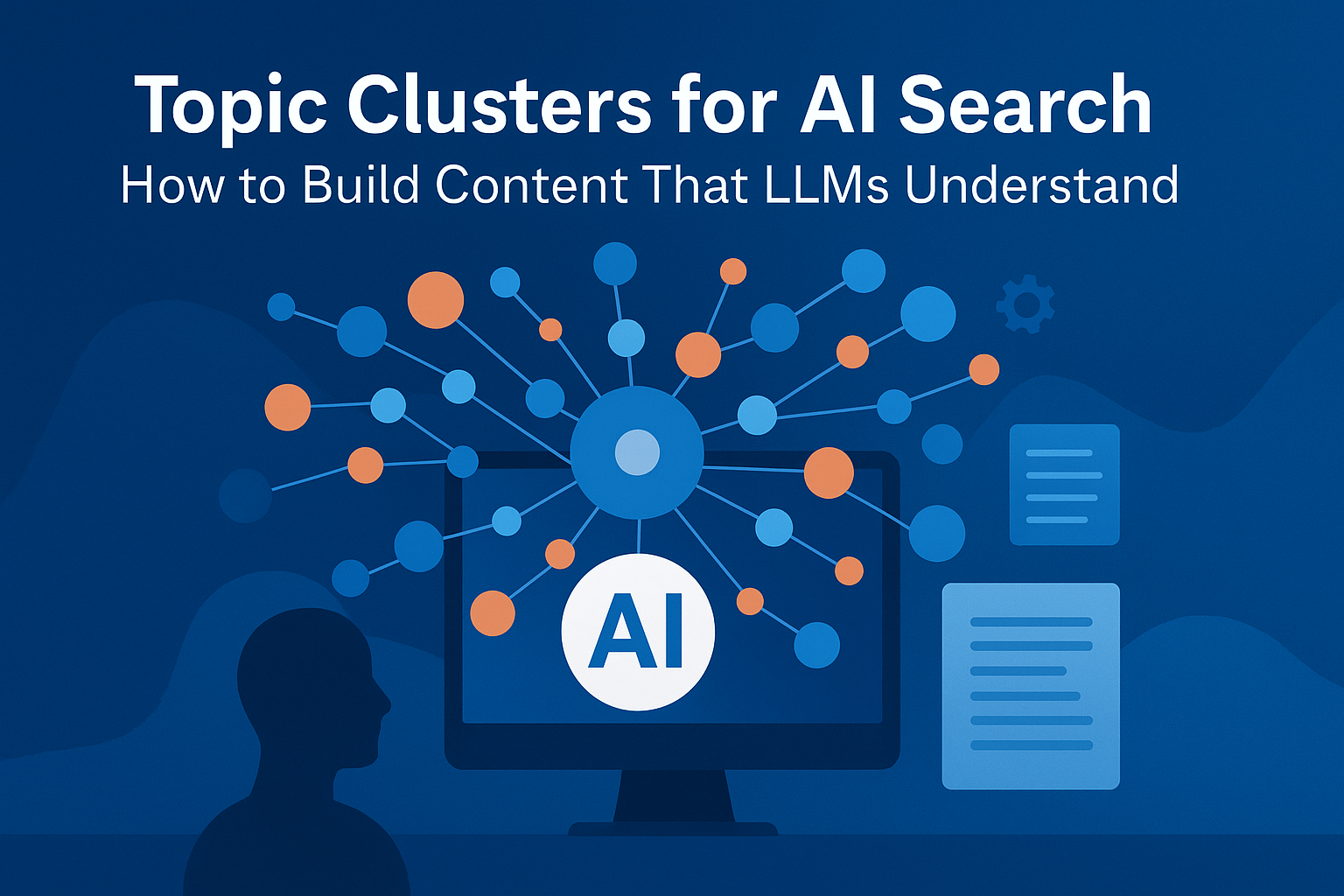
Learn how to build effective topic clusters that help AI search engines understand your content. Discover how structured clusters improve relevance, boost semantic authority, and increase your chances of being cited by ChatGPT, Perplexity, and Google AI Overviews.
TLDR
- Topic clusters improve how AI search engines interpret your content.
- A strong pillar page supported by focused cluster articles builds topical authority.
- Internal linking helps LLMs understand relationships between ideas.
- Well-structured clusters increase the likelihood of AI citations across modern search platforms.
- Consistent structure and semantic depth make your site more discoverable.
Topic clusters have quickly become one of the most important frameworks for improving visibility in AI-powered search.
Large Language Models such as ChatGPT, Gemini, Claude, and Perplexity rely on context and relationships between ideas, which means your content must be structured in a way that clearly communicates expertise and relevance.
If you want to understand the broader strategy behind AI-driven search visibility, check out our comprehensive guide on Answer Engine Optimisation to see how pillar pages set the foundation for effective AI citations.
A topic cluster gives your website that structure. It connects a single in-depth pillar page with several supporting articles that expand on key subtopics. When done well, this approach makes it easier for AI systems to understand what your content covers, how each piece relates, and why your site should be cited as a reliable source.
In this guide, you will learn how topic clusters work, why they matter for Answer Engine Optimisation, and how to build clusters that improve your presence across the growing landscape of AI-driven search.
What Topic Clusters Are and Why They Work for AI Search
A topic cluster is like a well-organised library for AI.
One in-depth pillar page covers a broad topic while several supporting articles dive into specific subtopics. This clear structure helps AI models and search engines understand your content and recognise your site as an authority.
For AI-powered search, topic clusters are a game-changer. LLMs do not just look at keywords. They analyse context, relationships, and content depth. To see how structured content like schema markup complements clusters, check our guide on Structured Data for AI Search.
When your articles are logically grouped and interlinked, AI can identify which pages are trustworthy and cite your content accurately in answer engines like ChatGPT, Perplexity, and Google AI Overviews.
Here is why clusters are so effective:
- They show AI that your site has authority on a topic rather than scattered information.
- They guide AI through a clear content path, helping it understand relationships between pages.
- They increase the likelihood of appearing in featured answers and AI citations.
- They improve semantic relevance, benefiting both AI and traditional SEO.
Clusters are not just about linking pages together. They create a cohesive story. Each supporting article reinforces your pillar topic, giving AI and your readers a clear understanding of the subject. Properly structured clusters make content more discoverable, authoritative, and likely to be cited across AI-powered platforms.
How LLMs Read and Interpret Topic Cluster Signals
AI-powered search engines analyse content by looking at context, relationships, and semantic relevance.
They do not focus solely on keywords. Instead, they evaluate how ideas connect across your site to determine which pages provide the most authoritative answers.

Topic clusters make this process more effective. Linking a pillar page to supporting articles creates a clear content hierarchy. AI can identify the main topic, understand how subtopics expand on it, and select the pages that best answer user queries.
Here is how AI interprets clusters:
- It assesses semantic relationships between the pillar and supporting pages to gauge topic depth
- It evaluates content relevance and context to choose the most reliable source for a query
- It uses internal links to understand how subtopics support the main theme
- It prioritises structured and thorough content that fully answers questions
Clusters also signal authority. When multiple supporting articles consistently reinforce the main topic, AI recognises your site as a reliable resource and is more likely to reference your content in answer engines.
By understanding how AI reads clusters, you can create content that is discoverable, authoritative, and positioned for citations and featured answers. Clear structure, semantic connections, and cohesive linking are the keys to building AI-friendly content.
AI Citations: How AI Chooses, Ranks, and References Content
AI citations are passages or pages that LLMs pull directly from the web to support or complete an answer.
Understanding how different platforms evaluate and select sources allows you to strategically structure content for higher citation potential.
ChatGPT Citation Selection
ChatGPT uses retrieval-augmented pipelines to identify relevant sources. Verified observations about citation triggers include:
- Passage-level clarity: Clean blocks of text, such as definitions, lists, or FAQ answers, are more likely to be cited than dense paragraphs.
- Domain-level and page-level authority: Trusted domains or highly authoritative pages increase citation likelihood.
- Freshness: More recent content is favoured for current topics.
Actionable tip: Format answers in short, extractable blocks (definition → example → FAQ) to increase the chance ChatGPT will pull them as references.
Perplexity Source Ranking
Perplexity uses a multi-step retrieval system with deeper evaluation than typical search engines:
- Multi-source aggregation: It pulls from several verified sources and compares consistency.
- Deep reference ranking: Citations are scored based on relevance, authority, and link provenance.
- E-E-A-T preference: Expert, experienced, and trustworthy domains are prioritised.
Actionable tip: Build clusters with strong internal linking and outbound citations to reputable sources. This improves how Perplexity interprets content authority and citation potential.
Google AI Overviews Passage Extraction
Google AI Overviews extracts passages that directly answer queries, prioritising clarity and structure:
- Content format preference: FAQ blocks, list-style summaries, and concise definitions are highly favoured.
- Passage length: Extracted blocks typically range between 35–200 words. Overly long or fragmented paragraphs reduce citation opportunities.
- Structured data signals: Schemas such as FAQ, HowTo, and Article (with author and review date) increase the chance a passage is selected.
Actionable tip: Use a structured content flow (intro → definition → example → FAQ) and schema markup to maximise passage retrieval for AI Overviews.
Triggering Citations with Structured, Authoritative Content
To strategically increase citation potential across platforms:
- Use extractable content blocks (definition, list, FAQ) rather than long, dense text.
- Ensure internal linking supports the pillar page and reinforces semantic relationships for Perplexity.
- Apply structured data consistently (FAQ, HowTo, Article schema) to aid Google AI Overviews.
- Focus on passage-level clarity and depth: each block should answer one high-intent question fully but concisely.
Choosing the Right Core Topic for Your Cluster
The foundation of a successful topic cluster is a well-chosen core topic.
The pillar page should cover a broad, relevant subject that positions your site as an authority. A strong core topic guides supporting articles and helps AI understand the hierarchy and purpose of your content.
Identifying Strong Pillar Topics
Select topics that are central to your niche and allow multiple supporting articles.
A focused core topic establishes expertise that AI can recognise and cite. Ensure it is broad enough to explore in depth but specific enough to remain authoritative.
Matching Search Intent and AI Potential
Consider the questions your audience asks and how AI may surface answers.
High-intent topics are more likely to be referenced in answer engines. Think about how ChatGPT, Perplexity, or Google AI Overviews might interpret and cite your content.
Avoiding Weak or Overly Broad Topics
Topics that are too general dilute authority, while topics that are too narrow may not support a robust cluster.
Aim for balance: the pillar page should be comprehensive, clear, and able to support related subtopics effectively.
Choosing the right core topic ensures your cluster is meaningful, discoverable, and positioned to earn citations. This step sets the stage for building supporting pages that reinforce your authority and relevance in AI-powered search.
Building Cluster Pages That LLMs Will Cite
Supporting articles form the backbone of a strong topic cluster.
Each page should explore a specific subtopic that complements your pillar page. Well-structured cluster pages improve user experience and help AI models understand your content hierarchy, making your site more likely to be cited in answer engines.
Map Subtopics to Support the Pillar
Start by identifying relevant subtopics that naturally branch from your core topic.
Each subtopic should have its own page with detailed, valuable information. This signals to AI that your site covers the topic comprehensively.
Structure Content for Clarity and Readability
Use clear headings, short paragraphs, and practical examples.
Lists and bullet points help highlight key information. Where applicable, structured data can make your content even more AI-friendly. This approach helps both readers and AI quickly grasp the main points.
Avoid Keyword Cannibalisation and Off-Topic Drift
Each cluster page should focus on a unique aspect of your pillar topic.
Avoid repeating content across pages or straying into unrelated areas. Clear boundaries make it easier for AI to understand the purpose of each page and how it contributes to the overall cluster.
By thoughtfully building cluster pages, you reinforce your pillar topic, provide real value to readers, and position your content for AI citations and featured answers. Proper planning and structure make your content discoverable, authoritative, and credible in AI-powered search.
Interlinking for AI Search: How to Create Strong Internal Signals
Internal linking is a critical part of building topic clusters that AI can easily understand.
By connecting your pillar page to supporting cluster articles, you create a clear content hierarchy that helps AI models identify relationships between pages and determine which ones to cite.
Guide AI Through Clear Paths
Links act as signposts for AI, showing how subtopics relate to the main pillar.
When every cluster page is linked thoughtfully, AI can follow the logical structure of your content and recognise which pages provide the most authoritative information.
Recommended Interlinking Patterns
- Link from the pillar page to each cluster article.
- Link back from each cluster article to the pillar.
- Where relevant, link related cluster articles to strengthen semantic relationships.
Linking Naturally
Avoid overloading pages with links.
Focus on contextual, natural connections that make sense to readers. This approach not only improves AI comprehension but also enhances user experience and site navigation.
Proper interlinking reinforces your topic clusters, boosts semantic signals, and increases the likelihood of AI-powered search engines citing your content. Well-structured internal links make your website easier to navigate and more authoritative in the eyes of both AI and users.
Common Mistakes That Break Topic Cluster Performance
Avoiding common pitfalls helps maintain authority, relevance, and AI citation potential:
- Overstuffing or repeating content: Repeating the same information across cluster pages dilutes topical authority. Each page should focus on a unique subtopic.
- Weak or missing internal links: Poorly structured or absent links make it harder for AI to understand relationships between pillar and supporting pages.
- Mixing multiple themes: Cluster pages that cover unrelated topics weaken semantic signals and confuse AI. Keep each article focused.
- Neglecting content updates: Outdated or thin pages reduce authority. Regularly update content to maintain relevance and AI trust.
Following these guidelines ensures your topic clusters remain discoverable, authoritative, and likely to be cited in AI-powered search results and featured answers.
Topic Clusters for AI Search: Final Thoughts
Building effective topic clusters takes planning, structure, and attention to detail.
From choosing the right pillar topic to creating well-organised cluster pages and maintaining semantic consistency, every step influences how AI-powered search engines understand and cite your content. Strong clusters increase visibility, improve the chances of featured answers, and position your brand as an authoritative source in your niche.
LangSync AI can help you take your content strategy to the next level. Our team specialises in Answer Engine Optimisation, LLM-optimised content, and AI-powered search visibility.
We create structured content clusters, optimise your internal linking, and ensure your website is positioned to be discovered and cited by AI platforms like ChatGPT, Perplexity, and Google AI Overviews.
To see how we can help your brand become a trusted source in AI-powered search and maximise your content’s reach.
Book a call with LangSync AI today