


Learn how structured data for AI search can improve visibility, boost citations, and help AI tools like ChatGPT and Perplexity understand and surface your content effectively.
Key Takeaways
- Structured data helps AI understand and accurately surface your content, a strategy recommended by AI SEO experts.
- Schema markup improves visibility on ChatGPT, Perplexity, and other AI tools.
- Geo-specific and industry-specific schemas increase relevance for local and niche searches.
- Implementing structured data correctly avoids errors and boosts AI citations.
- Monitoring performance ensures your content stays optimised for AI discovery.
Ever notice how some websites consistently appear in AI-generated answers while others are completely invisible? The difference is structured data.
This is not just about traditional SEO. By adding schema markup to your content, you make it easy for AI tools like ChatGPT, Perplexity, and other generative search engines to understand what your pages are about, cite them correctly, and show them to users.
In this guide, you will learn which types of structured data matter most, how to implement them on your website, common mistakes to avoid, and ways to track performance. You will also see how brands, with support from teams like LangSync AI, use structured data to boost their visibility in AI search and get their content noticed by the right audience.
What Is Structured Data and Schema Markup?
Structured data gives your content a clear, machine-readable format that AI can interpret.
It tells tools like ChatGPT or Perplexity exactly what each page or section is about, instead of leaving them to guess. Without it, even your best content can get lost, buried under pages that are easier for AI to understand.
Schema markup is the most common way to add structured data. It is a standardised code format, typically in JSON-LD, that resides in your website’s backend. AI tools like ChatGPT or Perplexity read this code to understand your content better.
Essential Schema Types for AI Search
Schema does not guarantee citations. Instead, schema improves machine understanding, entity clarity, and eligibility for search features. A schema is a supporting infrastructure that helps AI understand and correctly classify your content.
1. FAQ Schema (Use selectively)
Purpose:
Helps machines understand explicit Q&A intent. May be parsed by AI systems and search engines even if rich results are limited.
When to use
Only if:
- Questions are genuinely answered on the page
- Content is informational, not promotional
- FAQs are user-facing
Avoid on
- Sales pages
- Thin marketing blogs
Placement
- JSON-LD goes in <head>
- Questions must exactly match visible content
Example JSON-LD
<script type="application/ld+json">
{
"@context": "https://schema.org",
"@type": "FAQPage",
"mainEntity": [
{
"@type": "Question",
"name": "What is structured data for AI search?",
"acceptedAnswer": {
"@type": "Answer",
"text": "Structured data is a standardized format that helps machines understand, classify, and contextualize website content."
}
},
{
"@type": "Question",
"name": "Does structured data guarantee AI citations?",
"acceptedAnswer": {
"@type": "Answer",
"text": "No. Structured data improves content understanding and eligibility, but AI systems decide citations based on authority, relevance, and corroboration."
}
}
]
}
</script>
2. HowTo Schema (Only for real instructions)
Purpose:
Describes task-based, step-by-step processes.
When to use:
- Good for: technical guides, setup instructions, tutorials
- Not for: thought leadership, strategy articles, opinion pieces
Example JSON-LD
<script type="application/ld+json">
{

"@context": "https://schema.org",
"@type": "HowTo",
"name": "How to Implement Structured Data for Content Optimisation",
"step": [
{
"@type": "HowToStep",
"name": "Identify the page purpose",
"text": "Determine whether the page is informational, instructional, or commercial."
},
{
"@type": "HowToStep",
"name": "Choose one primary schema type",
"text": "Select the schema that best represents the page’s main intent."
},
{
"@type": "HowToStep",
"name": "Validate structured data",
"text": "Test the markup using schema validation tools to ensure accuracy."
}
]
}
</script>
3. Article / BlogPosting Schema (Core Requirement)
Purpose:
Defines the primary entity of the page and signals content type to AI and search engines.
Best Practices:
- One BlogPosting per article
- Must include: mainEntityOfPage, author, publisher, accurate dates, image
Example JSON-LD
<script type="application/ld+json">
{
"@context": "https://schema.org",
"@type": "BlogPosting",
"mainEntityOfPage": {
"@type": "WebPage",
"@id": "https://www.langsync.ai/blog/essential-schema-ai-search"
},
"headline": "Essential Schema Structured Data for AI Search Optimisation: Types & When to Use",
"description": "A practical guide to schema structured data, explaining which types to use, when to use them, and how they support machine understanding in modern AI-powered search systems.",
"image": "https://example.com/featured-image.png",
"author": {
"@type": "Person",
"name": "Felix Christian",
"url": "https://www.langsync.ai/about"
},
"publisher": {
"@type": "Organization",
"name": "LangSync AI",
"logo": {
"@type": "ImageObject",
"url": "https://example.com/logo.png"
}
},
"datePublished": "2026-01-26",
"dateModified": "2026-01-26"
}
</script>
4. Organisation Schema
Purpose:
Establishes brand identity and reinforces entity clarity.
Example JSON-LD
<script type="application/ld+json">
{
"@context": "https://schema.org",
"@type": "Organization",
"name": "LangSync AI",
"url": "https://www.langsync.ai",
"logo": "https://example.com/logo.png",
"sameAs": [
"https://www.linkedin.com/company/langsync-ai",
"https://twitter.com/langsyncai"
]
}
</script>
5. Person / Author Schema
Purpose:
Supports author credibility and entity recognition.
Example JSON-LD
<script type="application/ld+json">
{
"@context": "https://schema.org",
"@type": "Person",
"name": "Felix Christian",
"url": "https://www.langsync.ai/about",
"affiliation": {
"@type": "Organization",
"name": "LangSync AI"
},
"sameAs": [
"https://www.linkedin.com/in/ferderick-chinasa"
]
}
</script>
6. Product / Review Schema (Only if real)
Rule: Never mark up fake reviews or ratings.
Example JSON-LD
<script type="application/ld+json">
{
"@context": "https://schema.org",
"@type": "Product",
"name": "LangSync AI Structured Data Service",
"description": "Professional structured data implementation focused on machine understanding and entity optimisation.",
"offers": {
"@type": "Offer",
"url": "https://www.langsync.ai/services",
"priceCurrency": "USD",
"availability": "https://schema.org/InStock"
}
}
</script>
7. LocalBusiness Schema (Only if location matters)
Example JSON-LD
<script type="application/ld+json">
{
"@context": "https://schema.org",
"@type": "LocalBusiness",
"name": "LangSync AI",
"address": {
"@type": "PostalAddress",
"addressLocality": "Lagos",
"addressCountry": "NG"
},
"telephone": "+2341234567"
}
</script>
Best Practices for AI-Oriented Schema
- Keep one primary schema type per page
- Place all JSON-LD in <head>
- Match schema exactly to visible content
- Focus on entity clarity, not feature chasing
- Validate using Google Rich Results Test or Schema.org Validator
Avoid:
- Future-dated content
- Fake ratings or reviews
- Overlapping schemas with competing intent
- Assuming schema guarantees AI citations
Schema Types That Rarely Improve AI Search Visibility
Not every schema type meaningfully contributes to AI-driven search and answer engines. Some structured data exists primarily for traditional SERP features or UX enhancements and offers little value for AI systems focused on understanding, summarising, and citing content.
Using low-impact schema does not usually cause penalties, but it can dilute your core intent signals and distract from the schemas that actually matter.
Low-Impact Schema for AI Answer Engines
1. Breadcrumb Schema
Primary purpose: Site navigation and SERP display
Breadcrumb schema helps search engines understand page hierarchy, but it does not improve content interpretation for AI answer engines. AI systems prioritise page intent and entity clarity over navigation paths.
Use for:
- User experience
- Traditional SEO
Not effective for:
- AI citations
- Content summarisation
2. Event Schema (Unless Time-Critical)
Primary purpose: Upcoming, date-specific events
Event schema is useful when the event is real, current, and time-sensitive. For evergreen AI answers, this markup loses relevance quickly and does not support long-term AI visibility.
Use for: Live or upcoming events
Avoid for: Evergreen informational content
3. Sitelinks Search Box Schema
Primary purpose: Branded search enhancement
This schema type is designed to improve branded search experiences in Google. AI answer engines do not use it to assess content meaning, authority, or relevance.
AI impact: Minimal to none
4. Speakable Schema
Primary purpose: Voice assistants and news publishers
Speakable schema is often over-promoted in AI discussions. Modern AI systems extract quotable content based on clarity, structure, and context rather than speakable markup.
Better alternative:
- Clear headings
- Concise answers
- Well-structured paragraphs
5. Overlapping or Competing Schemas
Primary risk: Intent confusion
Applying multiple primary schemas (e.g., FAQ + HowTo + Product) to a single page often reduces clarity instead of improving it. AI systems perform best when each page communicates one dominant purpose.
Rule:
- One primary schema per page
- All other schemas should support, not compete
Key Principle
Schema is not about marking up everything possible.
It is about sending clear, consistent signals that help AI systems understand:
- What the page is
- What it is meant to do
- Who created it
In AI search, restraint often outperforms excess. Choosing what not to mark up is just as important as choosing what to include.
Why Structured Data Is a Game-Changer for AI Search
Structured data does more than just sit in your website’s code.
It tells AI exactly what your content is, how it’s organised, and how it relates to other information. Without it, AI has to guess, and guesswork rarely favours your content. Even excellent pages can remain invisible if AI cannot interpret them correctly.
It is important to note that structured data does not guarantee your content will appear in every AI tool. Instead, it improves how your content is indexed, interpreted, and retrieved by systems that generative AI models rely on. Think of structured data as increasing clarity and eligibility, not forcing visibility.
Here’s why it matters so much:
- Visibility in AI-driven answers: AI models like ChatGPT, Perplexity, and others prioritise content they can understand quickly. Structured data gives them that clarity, making your pages more likely to appear in summaries, answers, and recommendations.
- Greater likelihood of citation: AI prefers clear, credible, and well-structured content. Properly marked-up pages are more likely to be referenced directly in AI-generated results.
- Supports zero-click scenarios: Users increasingly get answers directly in AI tools without clicking. Structured data gives your content a shot at being that answer.
- E-E-A-T in action: Adding schema for your organisation, authors, or reviews signals authority and credibility. Skipping it is leaving visibility on the table.
The blunt truth is that structured data often determines whether your content gets noticed by AI or gets ignored. Brands that get it right consistently show up in AI-driven results. Those who don’t are basically relying on luck.
Structured Data for Answer Engines and ChatGPT
AI answer engines like ChatGPT, Perplexity, and other generative tools do more than crawl pages.
They try to understand and summarise content. Structured data makes that process a lot easier. Without it, AI has to guess what your page is about, which means even high-quality content can go unnoticed.
How to Implement Structured Data for AI Search (Step-by-Step)
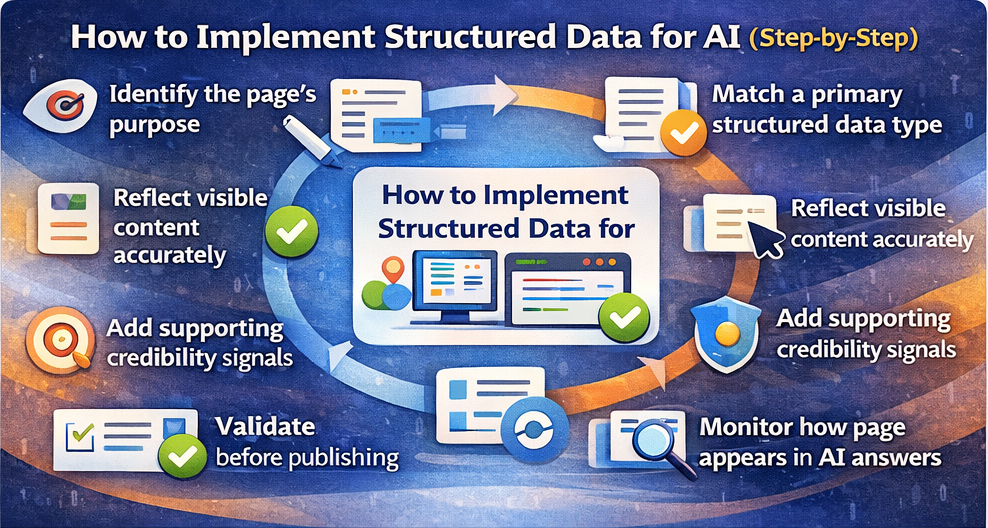
Step 1: Identify the purpose of the page
Decide what the page is actually meant to do. Is it answering questions, explaining a process, selling a product, promoting a service, or establishing authority? Each page should have one primary purpose, not several.
Step 2: Match the page to one primary structured data type
Choose the structured data type that best represents that purpose. For example, question-based pages should use FAQ-type markup, instructional content should be treated as a step-by-step guide, product pages should focus on product and review information, and brand pages should emphasise organisation and author credibility.
Step 3: Ensure the structured data reflects visible content exactly
Everything described in structured data must already exist on the page. If the page lists three questions, the structured data should reflect those same three questions. AI systems cross-check structured signals against visible content and will ignore or distrust mismatches.
Step 4: Add supporting credibility signals
Where applicable, include information about the organisation, author, location, or reviews. These elements help AI systems evaluate trust, expertise, and relevance, especially for competitive or sensitive topics.
Step 5: Validate before publishing
Before the page goes live, test the structured data to ensure there are no errors, missing fields, or misclassifications. Invalid or incomplete markup can prevent AI systems from using the data at all.
Step 6: Monitor how the page appears in AI-generated answers
After publishing, track whether the page is being referenced, summarised, or cited in AI tools. Pages that are not surfaced often need a clearer structure or more specific schema alignment.
Step 7: Review and update regularly
Structured data is not permanent. Content changes, business details change, and AI systems evolve. Revisit structured data during content updates to ensure it remains accurate and aligned with the page’s purpose.
Here is how structured data helps these tools:
- Clearly defines your content type: FAQ pages, HowTo guides, product listings, AI knows exactly what it is reading.
- Improves citation chances: AI prefers content that is clear, structured, and authoritative. A proper schema increases the likelihood that your content will be referenced in answers.
- Supports snippet-like results: For example, when ChatGPT answers a question directly, it often pulls from pages with structured data because it can interpret the information quickly.
- Boosts E-E-A-T: Including organisation, author, and review schema signals credibility to AI, which is increasingly important in generative search.
Following these steps ensures AI can interpret your content accurately, building credibility in generative search. Many brands underestimate this step. They publish content and hope AI notices it. Structured data acts like a VIP pass, telling AI exactly how to handle your page. Companies that get this right see their content surface reliably in AI answers. Those that skip it are leaving visibility to chance.
How to Track Structured Data Performance
Adding structured data is only half the battle.
The other half is making sure it actually works. Many brands implement schema and then assume AI will start citing their content immediately. That rarely happens. Monitoring performance ensures your effort pays off and highlights areas to improve.
Here is how to track structured data effectively:
- Use Google’s Rich Results Test
This tool lets you check if your structured data is valid and visible to AI. It is simple to use and highlights errors before they can affect your AI visibility. Fixing issues early can save weeks of lost exposure. - Monitor AI Search Performance
Keep an eye on which pages are appearing in AI-generated answers. While not all AI platforms provide detailed analytics, tools like Perplexity and ChatGPT summaries often reflect which content is being cited. - Track Citations and Mentions
Structured data is designed to get AI to cite your content. Monitor where and how often your content is being referenced. If pages are not being cited, it is usually a sign that your schema could be clearer or more specific. - Update and Refine Regularly
Structured data is not set-and-forget. Prices, availability, and even how content is written can affect AI interpretation. Regular audits ensure your markup stays accurate and your visibility remains high. - Use Professional Guidance When Needed
Some structured data strategies are more advanced, especially for large websites or complex content types. Partnering with experts ensures your implementation is optimised and continually aligned with evolving AI search standards.
Key takeaway
Measuring structured data performance is not just about validation.
It is about ensuring AI sees, trusts, and cites your content. Brands that monitor and refine their structured data consistently see better AI visibility, more citations, and higher engagement.
FAQs
What is structured data for AI search?
Why is structured data important for AI search?
Which types of structured data should I use?
How do I implement structured data effectively?
Can structured data boost visibility in generative AI tools like ChatGPT?
How does geo-specific or industry-specific schema help?
Structured data for AI Search: Final Thoughts
Structured data and schema markup are essential for AI to understand and cite your content.
They help tools like ChatGPT and Perplexity interpret your pages correctly, improving visibility, citations, and trustworthiness.
Implementing structured data effectively requires choosing the right schema types, validating your markup, and keeping information up to date. Brands that do this see measurable improvements in AI-driven results.
For businesses looking to maximise AI search impact, working with experts like LangSync AI can ensure structured data is implemented correctly and strategically. With the right guidance, your content can reach AI tools, earn credibility, and get noticed by the right audience.