


Discover how Google and Bing SEO influence ChatGPT visibility. We analysed 400 random keywords to test whether SEO performance on Google or Bing affects ChatGPT visibility.
TL;DR
- Google SEO strongly influences ChatGPT’s visibility, with 75% of keywords overlapping between Google first-page results and AI citations.
- Bing SEO has a weaker and less consistent impact, with only 55% of keywords overlapping.
- Structured webpages, clear headings, short paragraphs, and factual content increase the likelihood of being cited by ChatGPT.
- Guides, comparisons, “how-to” articles, and evergreen content perform best across search and AI.
- Strong branding and consistent messaging help AI recognise and reference your business.
- Optimising for clarity, credibility, and structure benefits both search rankings and AI visibility.
Search is evolving. People are no longer scrolling through Google results; they are asking AI tools like ChatGPT, Gemini, or Claude and getting immediate answers. This shift changes how brands are discovered and trusted online.
In this blog, we explore whether traditional SEO on Google and Bing still matters for AI visibility. Based on a study of 400 keywords, we reveal which factors drive citations in ChatGPT, what content performs best, and how brands can optimise for both search engines and AI-powered discovery.
Methodology
To find out whether strong SEO helps brands appear in ChatGPT’s answers, we built a simple but structured study. The goal? To see if there is a clear link between search visibility and how often ChatGPT mentions a brand.
Dataset
We analysed 400 random keywords drawn from a range of industries, including software, e-commerce, and productivity. Each keyword reflected a real search someone might make, such as:
- best CRM tools
- email automation software
- project management app.
To make the dataset balanced and representative, we grouped the keywords by intent and industry mix:
- 40% were informational (how-to, what-is, and guide-type queries).
- 30% were commercial or transactional (best, compare, buy, or pricing searches).
- 30% were mixed or navigational, often brand-specific or ambiguous searches
The keywords spanned six major sectors, including software, e-commerce, productivity tools, education, healthcare, and consumer technology. This balance gave us a clear view of how content intent and structure affect visibility across both search engines and AI-generated answers.
Metrics Collected
For every keyword, we measured:
- The number of brands ChatGPT mentioned in its answer
- Whether any of those brands appeared on Google’s first page
- The type of content that ranked (webpage, blog, or app page)
- The number of overlapping brands between ChatGPT and Google
- The same set of data was collected for Bing
This made it possible to see where ChatGPT’s citations matched traditional SEO performance and where they diverged.
Data Analysis
Once all the data was collected, we compared the results across all 400 keywords. We looked for patterns such as:
- How often brands mentioned by ChatGPT also ranked on Google or Bing
- Which content types appeared most frequently across both
- Which search engine showed stronger alignment with ChatGPT’s citations
- Whether the number of ChatGPT mentions is related to first-page visibility
These comparisons helped us understand how closely AI visibility connects to search performance and whether one search engine has more influence on ChatGPT’s output.
Limitations
ChatGPT’s responses can vary slightly depending on phrasing or model updates, so results represent a snapshot in time. We focused only on visibility, not sentiment, and limited our analysis to first-page search results.
Even with these boundaries, the study offers a clear view of how search performance and AI visibility intersect, and how Google and Bing differ in their influence on ChatGPT’s citations.
Key Findings: How Google and Bing SEO Affect ChatGPT Visibility
After analysing 400 keywords, we noticed some clear patterns in how ChatGPT connects with traditional search engines. Both Google and Bing influence visibility, but Google has a much stronger impact overall.
1. ChatGPT and Google: Strong Connection and Clear Overlap
ChatGPT and Google often show the same brands for similar searches. For example, when people look for tools, software, or advice, ChatGPT tends to mention the same websites that already rank well on Google.
What We Found
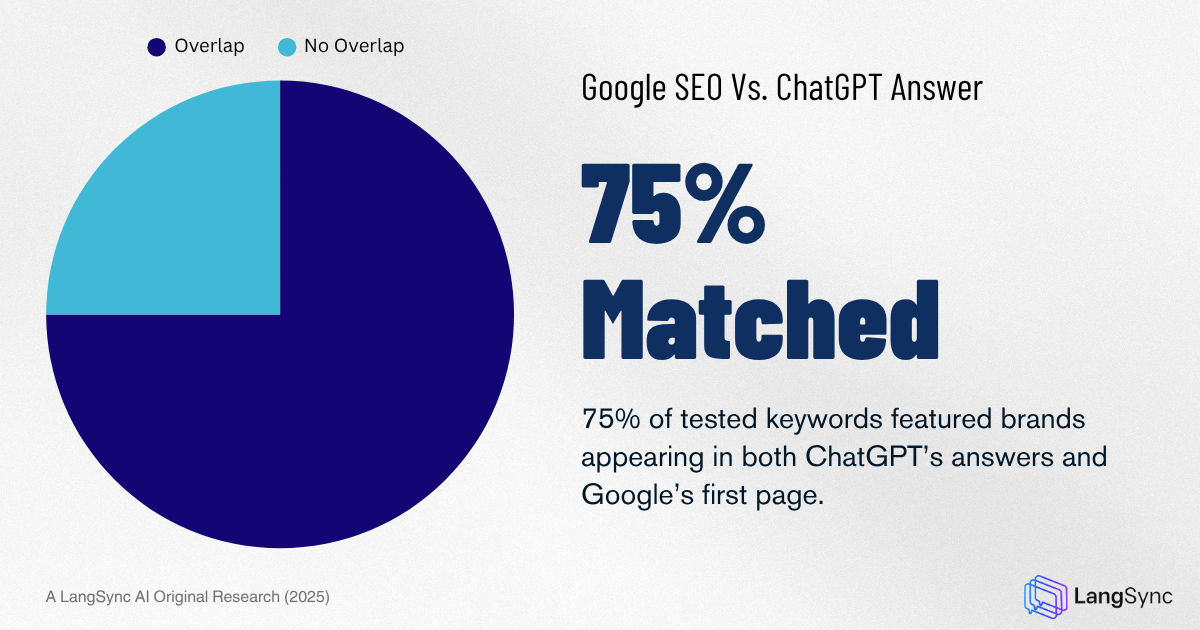
About 75% of all keywords had at least one brand that appeared both in ChatGPT’s answers and on Google’s first page.
The study found a strong link between Google rankings and ChatGPT visibility.
About 75% of the keywords tested had at least one brand that appeared in both ChatGPT’s responses and Google’s first-page results. On average, ChatGPT mentioned around five brands per query, and roughly two of those also ranked highly on Google.
Most of these overlaps came from structured webpages rather than blogs, with the clearest alignment seen in “how to”, “best”, and “top” style searches, the kinds of queries where users look for straightforward comparisons or guidance.
Why It Matters
Your Google SEO still shapes where and how your brand shows up, even beyond search results. Google and ChatGPT both value the same qualities: content that’s clear, accurate, and easy to understand.
When your website explains a topic simply and with structure, ChatGPT is more likely to include it in its answers.
If your site is unclear or outdated, it’s more likely to be missed, not only on Google but also in AI-generated results, where users increasingly get their information.
Tips for Businesses
- Write in plain, conversational language that answers real customer questions.
- Use short paragraphs, clear headings, and bullet points to make content easy to read.
- Keep facts accurate and cite credible sources.
- Publish guides, comparisons, and FAQs that help people make quick decisions.
Key Takeaway: Strong Google SEO increases the likelihood of being mentioned by ChatGPT. If your content is clear, useful, and trustworthy, it can perform well across both search engines and AI answers.
2. ChatGPT and Bing: Smaller Impact and Less Consistency
The connection between ChatGPT and Bing was much weaker. While there was some overlap, it was smaller, less frequent, and less stable than Google’s.
What We Found
The connection between Bing and ChatGPT was noticeably weaker.
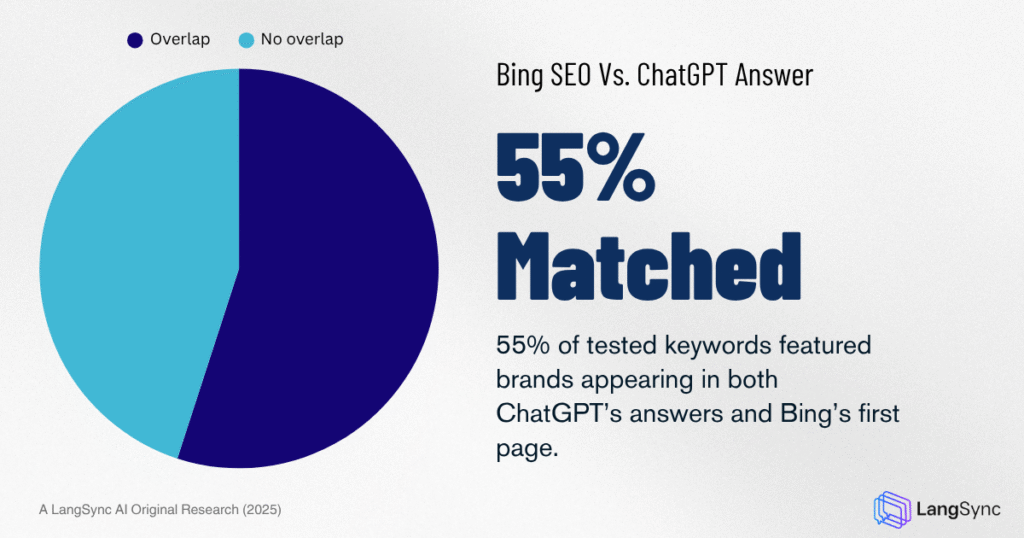
Only 55% of the tested keywords had any overlap between the two, and on average, fewer than two brands per query appeared in both Bing’s results and ChatGPT’s answers.
While Bing’s results mixed webpages and blogs, ChatGPT showed a stronger preference for structured, factual pages. The inconsistency of Bing’s rankings during testing also made its overlap with ChatGPT less stable and harder to predict.
Why It Matters
Focusing on Bing alone won’t help you appear in ChatGPT’s answers. ChatGPT relies more heavily on pages that are already strong performers on Google. If your brand only optimises for Bing, you could be missing the wider opportunity that AI-driven visibility offers.
Tips for Businesses
- Treat Bing as a useful extra channel, but base your strategy on Google-first optimisation.
- Keep your content clear, factual, and consistent across all platforms.
- Update older pages to match modern SEO and readability standards.
- Occasionally, check if your brand appears in ChatGPT’s answers to key industry questions.
Key Takeaway: Bing SEO has limited influence on ChatGPT visibility. The strongest results come from Google-quality content that’s easy for both search engines and AI systems to interpret and trust.
3. Comparing Google and Bing
When we compared both search engines, Google showed a noticeably stronger connection to ChatGPT’s responses.
The overlap was higher, and the type of content was more consistent. Brands that performed well on Google tended to appear in ChatGPT’s answers more often.
At a Glance
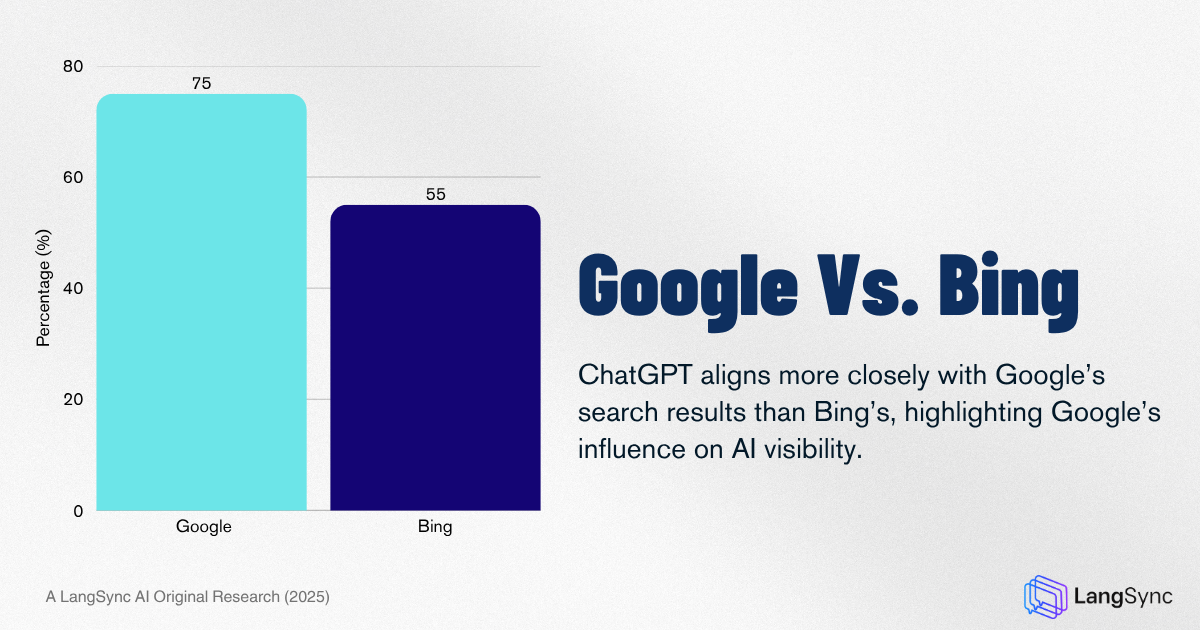
The comparison shows that Google aligns far more closely with ChatGPT than Bing does.
Around 75% of keywords overlapped between Google and ChatGPT, compared with just 55% for Bing. Google’s results were dominated by structured webpages, while Bing’s results included a broader mix of webpages and blogs, making its connection to ChatGPT’s responses less consistent.
What This Means
Google’s ranking system and ChatGPT’s responses are closely aligned. Bing’s influence seems weaker and less predictable.
For brands, this means that SEO still matters; it now shapes visibility in both search results and AI-generated answers.
Tips for Businesses
- Make sure your website is fast, mobile-friendly, and easy to navigate.
- Create guides, FAQs, and how-to articles that give real value to readers.
- Keep your data current and your brand message consistent.
- Review your top Google pages often and improve structure and clarity where needed.
Key Takeaway: Google remains the biggest driver of ChatGPT visibility. Brands that invest in clear, reliable, and well-structured content can appear not just on Google’s first page but also in the AI answers that millions of people now depend on.
Where to Focus: The Content Types That Win Across Search and ChatGPT
Not every piece of content performs equally across search and AI.
When we grouped the study keywords by search intent, two clear patterns appeared. Informational and commercial or transactional keywords don’t just differ by topic; they differ by the kind of content that performs best.
The study analysed 400 keywords drawn from six major sectors:
- Software
- E-commerce
- Productivity tools
- Education
- Healthcare
- consumer technology
Of these, 40% were informational queries like “how-to” or “what-is,” 30% were commercial or transactional searches such as “best,” “compare,” or “buy,” and the remaining 30% were mixed or navigational queries, often involving brands or broader topics.
This balance provided a clear picture of how different search intents perform across both traditional search engines and AI-generated answers.
This balanced dataset gave us a clear view of how content intent and format interact across industries and platforms.
Here’s what stood out:
- Webpages dominate across every intent: They accounted for around 77% of all overlaps between ChatGPT and Google, showing that both systems prefer structured, well-organised pages that are easy to read and summarise.
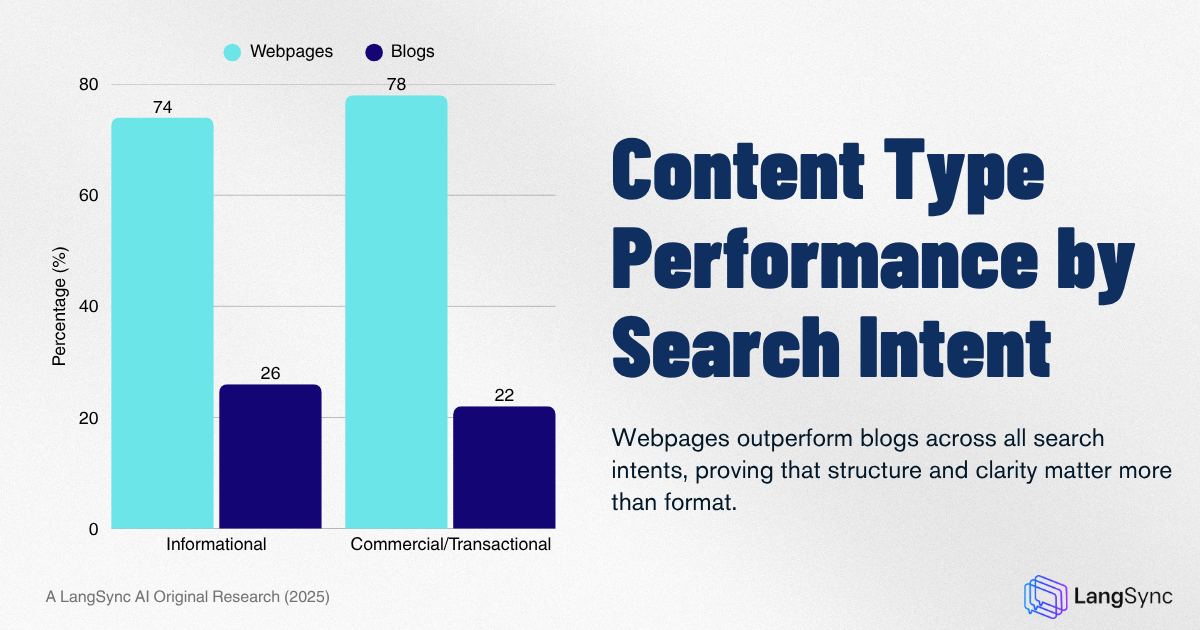
- Informational searches love clarity: For queries like “how to”, “what is”, and “guide to”, 74% of results were webpages, while blogs made up only 26%. Direct, factual content outperforms long, conversational pieces.
- Commercial and transactional searches favour structure over style: For keywords like “best”, “compare”, or “buy”, 78% of overlaps came from webpages, compared with 22% from blogs.
Even when users are ready to act, they still rely on structured guides and comparison pages over promotional copy. - Blogs play a supportive role: They appeared in roughly 23% of all overlaps but still help brands build credibility and connect related pages. They serve as a strong entry point that supports the visibility of the main webpages.
- Format matters as much as keywords: Across both intent types, structured layouts with headings, lists, and clear sections consistently performed better than dense or creative writing styles.
What This Means for Brands
If your content strategy leans heavily on blogs, it might be time to rebalance.
Webpages consistently outperform blogs across both informational and commercial searches, which shows that structure, not storytelling, drives AI visibility.
Focus on:
- Turning high-performing blog insights into structured guides or product pages.
- Keeping information concise, factual, and easy to scan.
- Using blogs to support discovery, link equity, and topic authority.
Key takeaway: Webpages win across every search intent. Around three out of four AI-cited results came from structured, clear, and factual webpages. If your goal is visibility both on Google and in AI answers, structure isn’t just helpful, it’s essential.
What Still Matters: The Factors That Help Brands Appear in AI Answers
From the study, we found that most of the things that help a page rank on Google also increase the likelihood it will be mentioned by ChatGPT. But not every SEO effort makes a difference. The study’s data shows what truly matters for AI-generated visibility, and what doesn’t.
Structured Pages Perform Better
ChatGPT consistently pulled information from well-organised pages.
About 95% of overlapping results between ChatGPT and Google came from regular webpages with clear sections, short paragraphs, and proper headings, while blogs made up less than 5%.
The strongest overlaps came from “how to” and “best” type searches, which tend to follow a simple, scannable format.
Good structure doesn’t just help readers, it helps AI understand your content. Long, messy pages were rarely used, even when the information was accurate. If you want to increase your chances of being cited, make your content easy to skim and clearly divided into sections.
Clarity and Neutral Writing Win
Pages that provided clear, factual, and balanced explanations were far more likely to appear in ChatGPT’s responses.
Informational-style queries such as “how”, “what”, and “best” produced the strongest overlaps, leading to a 75% alignment between ChatGPT and Google. In contrast, pages that focused on promotions or product sales had the weakest visibility.
This tells us something simple but powerful: ChatGPT values information that helps users learn, not language that tries to sell.
The more straightforward and useful your writing, the better your chances of appearing in AI answers.
Brand Clarity Matters
ChatGPT mentioned around 5 brands per query, and about 2 of those also appeared on Google’s first page.
This shows that strong brand identity, with consistent naming, product details, and messaging, helps AI systems recognise and match your business across sources.
When your brand name, offering, and description stay consistent across your website and profiles, ChatGPT can more easily connect your name to your area of expertise.
Evergreen and Informational Content Leads
Educational and evergreen content performed best.
Informational pages, especially guides and comparisons, made up the majority of overlaps between ChatGPT and Google. ChatGPT rarely cited direct product listings or sales pages, which matched Google’s own preference for value-driven content.
This means brands that invest in long-term, helpful resources, the kind of content people keep coming back to, are better positioned for both search and AI discovery.
Credibility Builds Trust
Accuracy and trustworthiness still shape visibility.
Pages that contained factual, up-to-date information were much more likely to overlap between ChatGPT and Google. Many “None” results, meaning no overlap, came from vague, outdated, or poorly sourced pages.
Both Google and ChatGPT reward reliability. The more your pages demonstrate expertise and use verified data, the higher your chances of being mentioned in AI responses.
Google Is Still the Main Gatekeeper
Our study confirmed that Google remains the most influential search engine when it comes to AI visibility.
About 75% of keywords had overlap between ChatGPT and Google, while only 55% overlapped with Bing. On average, there were 1.7 shared brands per query for Google and 0.9 for Bing.
This shows that Google’s content quality standards and ranking systems still guide what ChatGPT cites. For most brands, optimising for Google is effectively optimising for AI visibility too.
The Bottom Line
The fundamentals of SEO still matter, but their impact now extends beyond search results.
Clarity, structure, consistency, and credibility don’t just help your site rank; they help your brand become part of the answers AI systems provide.
If your content already meets Google’s standards, you’re not only competing in search, you’re also securing visibility in the next frontier of discovery, AI-generated answers.
ChatGPT Visibility vs Search Rankings: Closing Thought
Optimising for AI visibility is no longer a future goal; it’s the new baseline.
The brands that show up in AI answers are the ones shaping how people discover, compare, and decide. Search is evolving from clicks to conversations, and being cited by AI tools like ChatGPT is quickly becoming the new form of ranking.
For brands, the choice is simple: be part of the answer, or risk being left out of it.
To request the full dataset or book an AI Visibility Audit, get in touch with LangSync AI.
How LangSync Can Boost Your ChatGPT Visibility
Most brands are still optimising for clicks while their visibility quietly disappears into AI answers.
LangSync AI helps you stay seen in the era of AI-powered discovery by bridging the gap between SEO and AEO. We ensure your brand isn’t just ranked but referenced, appearing in the answers people now trust most.
Through audits, strategy, and optimisation, we show you where your brand appears inside ChatGPT, Gemini, and other AI systems, then help you strengthen your content’s clarity, authority, and structure to earn more mentions.
If you want your brand to be part of the answers, not just the search results, book an AI Visibility Audit with LangSync AI.
- 75.5% of ChatGPT-cited brands also ranked on Google’s first page, compared with 55.2% for Bing.
- Google shows a stronger correlation with ChatGPT citations than Bing.
- Webpages dominate overlap (91%), while blogs contribute marginally.
- The average ChatGPT response cites 5.4 brands, of which about two appear on Google.
- Google-first optimisation is the best bet for traditional SEO and AI-powered discovery.
The way people discover information is changing faster than ever.
Search is no longer just about ranking high on Google; it is about being referenced by AI systems that now answer millions of queries before a user even sees a search result.
Tools such as ChatGPT, Gemini and Perplexity are redefining visibility, reshaping how people find, trust and act on information. Brands are competing not only for clicks, but for mentions inside the answers themselves.
This raises a question every marketer and SEO is now asking: Does the work we do for Google or Bing still matter in the age of generative AI? Can a strong search ranking influence whether ChatGPT mentions a brand in its responses?
To find out, the team at LangSync AI, an AEO agency, analysed 400 random keywords across multiple industries and search intents to test how often ChatGPT’s brand mentions overlap with Google and Bing’s top search results.
The findings reveal how traditional SEO continues to shape AI visibility, why Google leads the generative curve, and what brands need to do to stay visible across both search and AI discovery.
Why This Study Matters
Search is changing fast. People aren’t typing long questions into Google and scrolling through pages of results anymore.
They’re asking ChatGPT, Gemini or Claude and getting their answers right away. That shift changes everything about how brands get noticed.
We wanted to figure out what still matters. Does good SEO help your brand show up in AI answers, or are these new tools playing by completely different rules?
Here’s why this study matters:
- Search is shifting as people move from digging through search results to getting quick, direct answers from AI, which changes how trust and visibility are built online.
- The rules of visibility are changing too, because traditional SEO focuses on links and rankings, while AI cares more about clear, accurate and well-structured information.
- There’s very little data showing how SEO and AI visibility connect, so this study helps reveal how often strong search performance leads to mentions inside ChatGPT’s answers.
- Google and Bing don’t influence AI in the same way, and comparing both helps us see which one plays a bigger role in shaping what ChatGPT cites.
- The game is moving from ranking high to being recognised and trusted, which means the brands that stand out will be the ones AI systems understand and choose to mention.
We’re entering a world where showing up isn’t just about being clickable; it’s about being credible. This study explores how search and AI now work together, and what that means for every brand trying to stay visible.
Methodology
To find out whether strong SEO helps brands appear in ChatGPT’s answers, we built a simple but structured study. The goal? To see if there is a clear link between search visibility and how often ChatGPT mentions a brand.
Dataset
We analysed 400 random keywords drawn from a range of industries, including software, e-commerce, and productivity. Each keyword reflected a real search someone might make, such as:
- best CRM tools
- email automation software
- project management app.
To make the dataset balanced and representative, we grouped the keywords by intent and industry mix:
- 40% were informational (how-to, what-is, and guide-type queries).
- 30% were commercial or transactional (best, compare, buy, or pricing searches).
- 30% were mixed or navigational, often brand-specific or ambiguous searches
The keywords spanned six major sectors, including software, e-commerce, productivity tools, education, healthcare, and consumer technology. This balance gave us a clear view of how content intent and structure affect visibility across both search engines and AI-generated answers.
Metrics Collected
For every keyword, we measured:
- The number of brands ChatGPT mentioned in its answer
- Whether any of those brands appeared on Google’s first page
- The type of content that ranked (webpage, blog, or app page)
- The number of overlapping brands between ChatGPT and Google
- The same set of data was collected for Bing
This made it possible to see where ChatGPT’s citations matched traditional SEO performance and where they diverged.
Data Analysis
Once all the data was collected, we compared the results across all 400 keywords. We looked for patterns such as:
- How often brands mentioned by ChatGPT also ranked on Google or Bing
- Which content types appeared most frequently across both
- Which search engine showed stronger alignment with ChatGPT’s citations
- Whether the number of ChatGPT mentions is related to first-page visibility
These comparisons helped us understand how closely AI visibility connects to search performance and whether one search engine has more influence on ChatGPT’s output.
Limitations
ChatGPT’s responses can vary slightly depending on phrasing or model updates, so results represent a snapshot in time. We focused only on visibility, not sentiment, and limited our analysis to first-page search results.
Even with these boundaries, the study offers a clear view of how search performance and AI visibility intersect, and how Google and Bing differ in their influence on ChatGPT’s citations.
Key Findings: How Google and Bing SEO Affect ChatGPT Visibility
After analysing 400 keywords, we noticed some clear patterns in how ChatGPT connects with traditional search engines. Both Google and Bing influence visibility, but Google has a much stronger impact overall.
1. ChatGPT and Google: Strong Connection and Clear Overlap
ChatGPT and Google often show the same brands for similar searches. For example, when people look for tools, software, or advice, ChatGPT tends to mention the same websites that already rank well on Google.
What We Found
About 75% of all keywords had at least one brand that appeared both in ChatGPT’s answers and on Google’s first page.
The study found a strong link between Google rankings and ChatGPT visibility.
About 75% of the keywords tested had at least one brand that appeared in both ChatGPT’s responses and Google’s first-page results. On average, ChatGPT mentioned around five brands per query, and roughly two of those also ranked highly on Google.
Most of these overlaps came from structured webpages rather than blogs, with the clearest alignment seen in “how to”, “best”, and “top” style searches, the kinds of queries where users look for straightforward comparisons or guidance.
Why It Matters
Your Google SEO still shapes where and how your brand shows up, even beyond search results. Google and ChatGPT both value the same qualities: content that’s clear, accurate, and easy to understand.
When your website explains a topic simply and with structure, ChatGPT is more likely to include it in its answers.
If your site is unclear or outdated, it’s more likely to be missed, not only on Google but also in AI-generated results, where users increasingly get their information.
Tips for Businesses
- Write in plain, conversational language that answers real customer questions.
- Use short paragraphs, clear headings, and bullet points to make content easy to read.
- Keep facts accurate and cite credible sources.
- Publish guides, comparisons, and FAQs that help people make quick decisions.
Key Takeaway: Strong Google SEO increases the likelihood of being mentioned by ChatGPT. If your content is clear, useful, and trustworthy, it can perform well across both search engines and AI answers.
2. ChatGPT and Bing: Smaller Impact and Less Consistency
The connection between ChatGPT and Bing was much weaker. While there was some overlap, it was smaller, less frequent, and less stable than Google’s.
What We Found
The connection between Bing and ChatGPT was noticeably weaker.
Only 55% of the tested keywords had any overlap between the two, and on average, fewer than two brands per query appeared in both Bing’s results and ChatGPT’s answers.
While Bing’s results mixed webpages and blogs, ChatGPT showed a stronger preference for structured, factual pages. The inconsistency of Bing’s rankings during testing also made its overlap with ChatGPT less stable and harder to predict.
Why It Matters
Focusing on Bing alone won’t help you appear in ChatGPT’s answers. ChatGPT relies more heavily on pages that are already strong performers on Google. If your brand only optimises for Bing, you could be missing the wider opportunity that AI-driven visibility offers.
Tips for Businesses
- Treat Bing as a useful extra channel, but base your strategy on Google-first optimisation.
- Keep your content clear, factual, and consistent across all platforms.
- Update older pages to match modern SEO and readability standards.
- Occasionally, check if your brand appears in ChatGPT’s answers to key industry questions.
Key Takeaway: Bing SEO has limited influence on ChatGPT visibility. The strongest results come from Google-quality content that’s easy for both search engines and AI systems to interpret and trust.
3. Comparing Google and Bing
When we compared both search engines, Google showed a noticeably stronger connection to ChatGPT’s responses.
The overlap was higher, and the type of content was more consistent. Brands that performed well on Google tended to appear in ChatGPT’s answers more often.
At a Glance
The comparison shows that Google aligns far more closely with ChatGPT than Bing does.
Around 75% of keywords overlapped between Google and ChatGPT, compared with just 55% for Bing. Google’s results were dominated by structured webpages, while Bing’s results included a broader mix of webpages and blogs, making its connection to ChatGPT’s responses less consistent.
What This Means
Google’s ranking system and ChatGPT’s responses are closely aligned. Bing’s influence seems weaker and less predictable.
For brands, this means that SEO still matters; it now shapes visibility in both search results and AI-generated answers.
Tips for Businesses
- Make sure your website is fast, mobile-friendly, and easy to navigate.
- Create guides, FAQs, and how-to articles that give real value to readers.
- Keep your data current and your brand message consistent.
- Review your top Google pages often and improve structure and clarity where needed.
Key Takeaway: Google remains the biggest driver of ChatGPT visibility. Brands that invest in clear, reliable, and well-structured content can appear not just on Google’s first page but also in the AI answers that millions of people now depend on.
Where to Focus: The Content Types That Win Across Search and ChatGPT
Not every piece of content performs equally across search and AI.
When we grouped the study keywords by search intent, two clear patterns appeared. Informational and commercial or transactional keywords don’t just differ by topic; they differ by the kind of content that performs best.
The study analysed 400 keywords drawn from six major sectors:
- Software
- E-commerce
- Productivity tools
- Education
- Healthcare
- consumer technology
Of these, 40% were informational queries like “how-to” or “what-is,” 30% were commercial or transactional searches such as “best,” “compare,” or “buy,” and the remaining 30% were mixed or navigational queries, often involving brands or broader topics.
This balance provided a clear picture of how different search intents perform across both traditional search engines and AI-generated answers.
This balanced dataset gave us a clear view of how content intent and format interact across industries and platforms.
Here’s what stood out:
- Webpages dominate across every intent: They accounted for around 77% of all overlaps between ChatGPT and Google, showing that both systems prefer structured, well-organised pages that are easy to read and summarise.
- Informational searches love clarity: For queries like “how to”, “what is”, and “guide to”, 74% of results were webpages, while blogs made up only 26%. Direct, factual content outperforms long, conversational pieces.
- Commercial and transactional searches favour structure over style: For keywords like “best”, “compare”, or “buy”, 78% of overlaps came from webpages, compared with 22% from blogs.
Even when users are ready to act, they still rely on structured guides and comparison pages over promotional copy. - Blogs play a supportive role: They appeared in roughly 23% of all overlaps but still help brands build credibility and connect related pages. They serve as a strong entry point that supports the visibility of the main webpages.
- Format matters as much as keywords: Across both intent types, structured layouts with headings, lists, and clear sections consistently performed better than dense or creative writing styles.
What This Means for Brands
If your content strategy leans heavily on blogs, it might be time to rebalance.
Webpages consistently outperform blogs across both informational and commercial searches, which shows that structure, not storytelling, drives AI visibility.
Focus on:
- Turning high-performing blog insights into structured guides or product pages.
- Keeping information concise, factual, and easy to scan.
- Using blogs to support discovery, link equity, and topic authority.
Key takeaway: Webpages win across every search intent. Around three out of four AI-cited results came from structured, clear, and factual webpages. If your goal is visibility both on Google and in AI answers, structure isn’t just helpful, it’s essential.
What Still Matters: The Factors That Help Brands Appear in AI Answers
From the study, we found that most of the things that help a page rank on Google also increase the likelihood it will be mentioned by ChatGPT. But not every SEO effort makes a difference. The study’s data shows what truly matters for AI-generated visibility, and what doesn’t.
Structured Pages Perform Better
ChatGPT consistently pulled information from well-organised pages.
About 95% of overlapping results between ChatGPT and Google came from regular webpages with clear sections, short paragraphs, and proper headings, while blogs made up less than 5%.
The strongest overlaps came from “how to” and “best” type searches, which tend to follow a simple, scannable format.
Good structure doesn’t just help readers, it helps AI understand your content. Long, messy pages were rarely used, even when the information was accurate. If you want to increase your chances of being cited, make your content easy to skim and clearly divided into sections.
Clarity and Neutral Writing Win
Pages that provided clear, factual, and balanced explanations were far more likely to appear in ChatGPT’s responses.
Informational-style queries such as “how”, “what”, and “best” produced the strongest overlaps, leading to a 75% alignment between ChatGPT and Google. In contrast, pages that focused on promotions or product sales had the weakest visibility.
This tells us something simple but powerful: ChatGPT values information that helps users learn, not language that tries to sell.
The more straightforward and useful your writing, the better your chances of appearing in AI answers.
Brand Clarity Matters
ChatGPT mentioned around 5 brands per query, and about 2 of those also appeared on Google’s first page.
This shows that strong brand identity, with consistent naming, product details, and messaging, helps AI systems recognise and match your business across sources.
When your brand name, offering, and description stay consistent across your website and profiles, ChatGPT can more easily connect your name to your area of expertise.
Evergreen and Informational Content Leads
Educational and evergreen content performed best.
Informational pages, especially guides and comparisons, made up the majority of overlaps between ChatGPT and Google. ChatGPT rarely cited direct product listings or sales pages, which matched Google’s own preference for value-driven content.
This means brands that invest in long-term, helpful resources, the kind of content people keep coming back to, are better positioned for both search and AI discovery.
Credibility Builds Trust
Accuracy and trustworthiness still shape visibility.
Pages that contained factual, up-to-date information were much more likely to overlap between ChatGPT and Google. Many “None” results, meaning no overlap, came from vague, outdated, or poorly sourced pages.
Both Google and ChatGPT reward reliability. The more your pages demonstrate expertise and use verified data, the higher your chances of being mentioned in AI responses.
Google Is Still the Main Gatekeeper
Our study confirmed that Google remains the most influential search engine when it comes to AI visibility.
About 75% of keywords had overlap between ChatGPT and Google, while only 55% overlapped with Bing. On average, there were 1.7 shared brands per query for Google and 0.9 for Bing.
This shows that Google’s content quality standards and ranking systems still guide what ChatGPT cites. For most brands, optimising for Google is effectively optimising for AI visibility too.
The Bottom Line
The fundamentals of SEO still matter, but their impact now extends beyond search results.
Clarity, structure, consistency, and credibility don’t just help your site rank; they help your brand become part of the answers AI systems provide.
If your content already meets Google’s standards, you’re not only competing in search, you’re also securing visibility in the next frontier of discovery, AI-generated answers.
FAQs
Does Google SEO affect ChatGPT’s visibility?
Does Bing SEO influence ChatGPT’s visibility?
How does website structure affect ChatGPT’s visibility?
What types of content perform best in both search and ChatGPT?
Does ChatGPT’s visibility depend on brand consistency?
Can optimising for SEO also boost AI visibility?
ChatGPT Visibility vs Search Rankings: Closing Thought
Optimising for AI visibility is no longer a future goal; it’s the new baseline.
The brands that show up in AI answers are the ones shaping how people discover, compare, and decide. Search is evolving from clicks to conversations, and being cited by AI tools like ChatGPT is quickly becoming the new form of ranking.
For brands, the choice is simple: be part of the answer, or risk being left out of it.
To request the full dataset or book an AI Visibility Audit, Contact LangSync AI.
How LangSync Can Boost Your ChatGPT Visibility
Most brands are still optimising for clicks while their visibility quietly disappears into AI answers.
LangSync AI helps you stay seen in the era of AI-powered discovery by bridging the gap between SEO and AEO. We ensure your brand isn’t just ranked but referenced, appearing in the answers people now trust most.
Through audits, strategy, and optimisation, we show you where your brand appears inside ChatGPT, Gemini, and other AI systems, then help you strengthen your content’s clarity, authority, and structure to earn more mentions.
If you want your brand to be part of the answers, not just the search results, book an AI Visibility Audit with LangSync AI.