


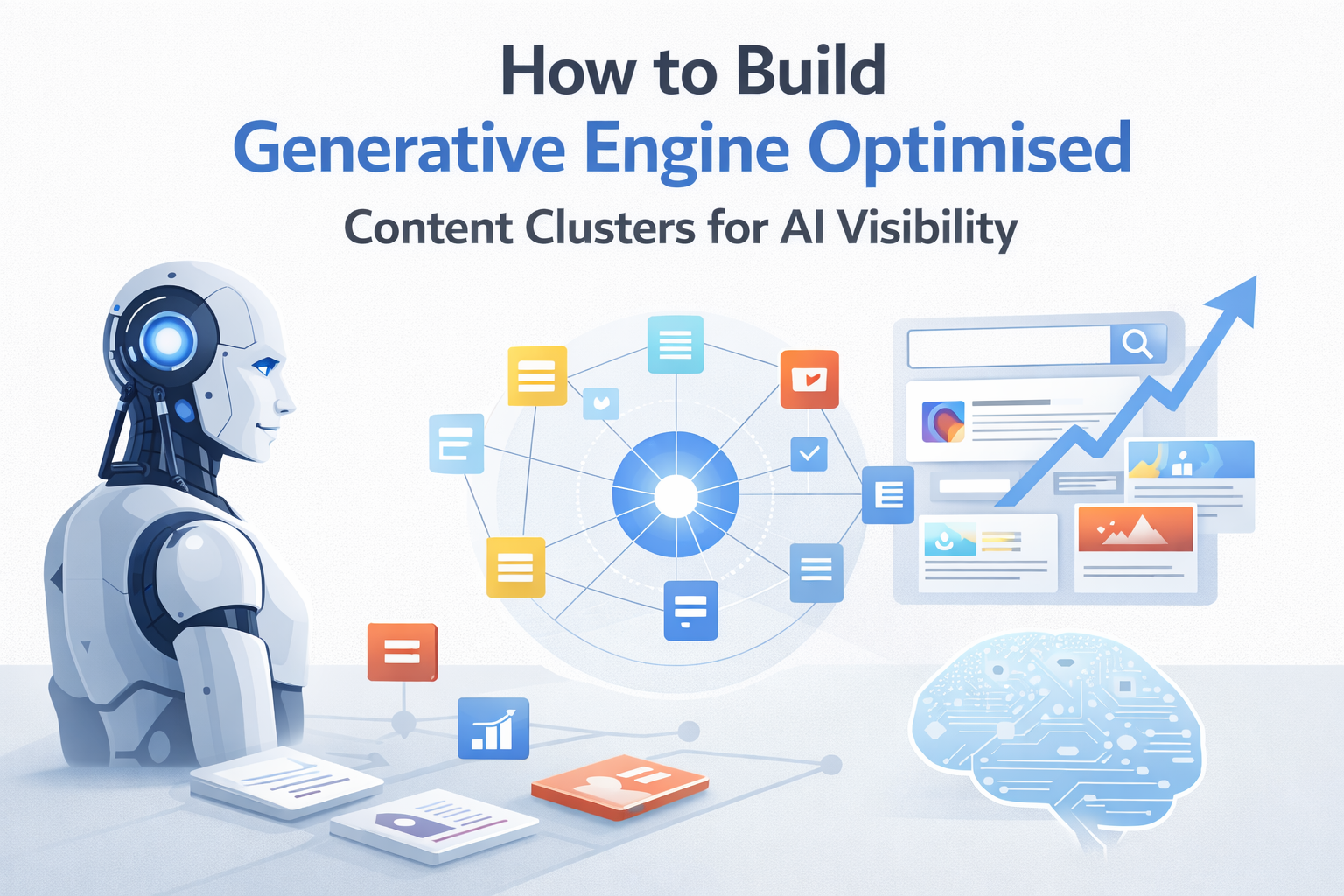
Learn how to structure Generative Engine Optimised content clusters that AI recognises and surfaces consistently. Discover strategies for pillar and cluster pages, linking, and authority reinforcement in generative search.
Why GEO Content Clusters Are Essential for AI Visibility
Strong individual pages are rarely enough to earn consistent recognition in AI-powered search. AI evaluates content differently than traditional search engines—it looks for patterns, connections, and context across multiple pages, rather than judging a single page in isolation.
Generative Engine Optimised (GEO) content clusters solve this problem. By linking a central pillar page with supporting cluster articles, you create a clear content ecosystem that signals authority to AI. Clusters make it easier for AI to understand the topic, identify which pages are most relevant, and surface your content consistently in answers and summaries.
In this section, we will explore:
- Why single pages often fail to get noticed by AI and how clusters address this gap
- How AI evaluates authority across multiple connected pages
- Practical approaches to structure pillar and cluster pages for maximum visibility
- Internal linking strategies that reinforce cluster authority
Following these principles provides a professional, actionable framework for building GEO content clusters. Observations from multiple audits show that when pages are structured and connected thoughtfully, AI is far more likely to cite them and maintain long-term visibility.
How AI Recognises Authority Across Multiple Pages
AI does not evaluate pages in isolation.
Instead, it looks for patterns, consistency, and connections across multiple pieces of content. Authority emerges from relationships, not from a single page acting alone. Understanding this behaviour helps content creators design clusters that AI can recognise, cite, and surface reliably.
Over the years, across SaaS and content-led blogs, we have observed that clusters with strong interconnections are far more likely to be referenced in AI-generated answers than standalone pages, even when individual pages are well-written.
Key observations
- Topic maps and relationships: AI evaluates how pages relate to one another. Pages that cover related topics and link logically signal expertise and authority. On its own, a single page may look complete, but it often exists as part of a larger content ecosystem. Organising around a central theme allows each page to reinforce the others.
- Consistency signals: Repeated coverage of a topic across multiple pages demonstrates depth. Consistency in headings, terminology, and structure strengthens AI confidence. Small inconsistencies in phrasing or formatting can reduce trust, so maintaining clear patterns is essential.
- Linking logic: Thoughtful internal links show which pages are central references and which provide supporting details. Pages that are unlinked or loosely connected may be overlooked. Strategic linking ensures AI can follow the logical flow of your content and recognise which pages carry the most authority.
- Content hierarchy: How information is organised across the cluster matters. Pillar pages serve as anchors, while supporting pages provide context and depth. This hierarchy helps AI prioritise content for citations and answers.
When AI can see how your ideas connect across pages, it is far more likely to trust your content. Building authority is not just about writing well; it is about demonstrating relationships, depth, and consistency. Clusters that reflect these qualities are more consistently surfaced in AI-driven outputs, including summaries, answer boxes, and recommendations.
Core Components of a GEO Content Cluster
A GEO content cluster is more than a group of related pages.
It functions as a connected system designed to help AI recognise authority, understand context, and surface information consistently. Clusters work best when each component has a clear role and communicates that role through structure and connection.
Key components
- Pillar Page
The pillar page acts as the authoritative centre. It introduces the main topic, sets context, and links to supporting content. For AI, the pillar clarifies the scope of the cluster and highlights which page serves as the primary reference. - Supporting Cluster Pages
These pages explore specific subtopics in greater detail. Each reinforces the pillar by expanding on related ideas and linking back. Together, they demonstrate depth rather than isolated coverage. - Internal Linking Strategy
Internal links show hierarchy and relationships. Thoughtful linking helps AI identify which pages are central and which are supportive. It also guides readers through content in a logical way. - Consistent Structure and Format
Patterns matter. Clear headings, short paragraphs, and consistent terminology make content easier for AI to parse and compare. For humans, it improves readability and comprehension. - Structured Data Implementation
Schemas such as FAQ, HowTo, Product, and Article provide explicit context. Structured data helps AI interpret the purpose, relationships, and relevance of each page within the cluster, which is explored in more detail in structured data for Generative Engine Optimisation. - Topic Relevance and Depth
Every page should meaningfully contribute to the main topic. Clusters lose strength when pages drift off-topic or overlap unnecessarily. Focused, in-depth coverage reinforces authority.
When clarity, hierarchy, and connectivity work together, AI can understand your content more easily. Authority emerges naturally, increasing the likelihood your pages are cited and surfaced consistently in generative search results.
Step-by-Step Guide to Building Your GEO Content Cluster
Creating a GEO content cluster is about more than linking related pages.
It requires intentional structure, clear roles for each page, and connections that AI can interpret. When done right, clusters help AI recognise authority, understand context, and surface your content consistently.
Here is a practical roadmap for building a cluster that works for both AI and human readers:
Step 1: Define Your Pillar Topic
The pillar page is the central hub of your cluster.
Choose a topic broad enough to support multiple subtopics but focused enough to show expertise. The pillar should summarise the main ideas, provide context, and clearly signal to AI the primary focus of your cluster. In practice, strong pillars consistently outperform isolated pages in AI citations.
Step 2: Identify Supporting Subtopics
Break your main topic into distinct supporting pages, each addressing a specific subtopic.
This prevents overlap and signals depth to AI. Supporting pages should reinforce the pillar and expand on related concepts. Over the years, we’ve noticed that clusters with tightly aligned supporting pages are cited more frequently than those with loosely connected content.
Step 3: Plan Internal Linking Carefully
Internal links are more than navigation; they communicate hierarchy and relationships.
Each supporting page should link back to the pillar, and where relevant, to other supporting pages. AI evaluates these links as authority signals. Thoughtful linking also guides readers naturally through your content ecosystem.
Step 4: Maintain Consistent Structure
Headings, paragraph length, and formatting patterns matter.
A clear, scannable structure allows AI to parse information efficiently and helps readers follow your argument without friction. Even small inconsistencies can weaken AI recognition, so aim for uniformity across your cluster.
Step 5: Implement Structured Data
Schemas such as FAQ, HowTo, Product, and Article provide explicit context to AI.
Structured data communicates page purpose, relationships, and relevance within the cluster, helping AI surface the right content in answers and summaries. Proper schema implementation is a small step that yields measurable benefits.
Step 6: Ensure Focus and Depth
Every page should contribute meaningfully to the pillar topic.
Avoid off-topic content or repetition. Depth signals authority, while focus ensures clarity. When AI observes consistent, in-depth coverage across a cluster, the likelihood of your pages being cited in generative outputs increases.
Clusters succeed when clarity, structure, linking, and relevance work together. AI can recognise authority, understand context, and surface your content reliably. For readers, the experience is logical, connected, and easy to navigate.
Smart Internal Linking for GEO Authority
Internal linking is more than a navigation tool.
It is a strategic signal to AI about the relationships, hierarchy, and authority of your content. In a GEO cluster, thoughtful linking ensures that AI recognises the pillar page as the central reference and understands how each cluster article contributes to the broader topic.
Key strategies for effective internal linking:
- Link cluster articles back to the pillar page:
This reinforces the pillar as the authoritative hub, making it clear to AI that it is the primary resource for the topic. - Cross-link related cluster articles:
When subtopics overlap or complement each other, linking them together helps AI see the content ecosystem as cohesive and well-structured. - Use descriptive, topic-relevant anchor text:
Replace generic phrases like “click here” with specific, context-driven phrases. For example, “LLM-Optimised Content Strategies” tells AI exactly what the linked page covers. - Maintain a logical hierarchy:
Structure links to reflect content importance. Pillar pages sit at the top, cluster articles support the pillar, and supporting resources or examples can be tertiary. - Contextual and natural placement:
Links should appear where they add clarity or value, not just to increase link counts. AI interprets links in context, so strategic placement enhances understanding.
Why this matters for GEO
- Proper linking ensures AI can navigate the cluster efficiently, identifying relationships between pages.
- It strengthens the perceived authority of your content by demonstrating a well-organised knowledge network.
- AI can surface the most relevant pages for queries, increasing the likelihood that your content appears in answers, summaries, and generative search results.
By designing internal links with purpose, your GEO cluster not only improves AI comprehension but also enhances discoverability, topical authority, and long-term visibility.
Measuring the Success of Your GEO Cluster
Tracking the effectiveness of your GEO content cluster requires a different approach than traditional SEO. Success is not just about rankings.
It is about understanding how AI recognises, trusts, and reuses your content over time. To measure this effectively, focus on both key metrics and practical monitoring steps.
Key Metrics to Monitor
Measuring the success of your GEO cluster goes beyond traditional SEO metrics.
These key indicators show how AI recognises, trusts, and reuses your content. By monitoring these signals, you can see which pages are performing, which topics are being surfaced, and where improvements are needed to strengthen authority across your cluster.
AI Mentions and Citations
Track how often pages from your cluster are referenced or included in AI-generated answers, summaries, or recommendations. Supporting pages are often cited first, with recognition extending to the pillar over time.
Answer Engine Inclusion
Monitor whether your pages appear in generative search or AI-powered answer engines for relevant queries. Frequent inclusion indicates that AI understands the cluster as a coherent topic system.
Structured Content Engagement
Check how AI interprets your structured data, such as FAQ or HowTo schemas. Well-implemented structured content increases the likelihood that your pages are surfaced correctly.
Topical Authority Signals
Observe how consistently AI connects cluster articles to the pillar and related subtopics. Strong cross-page connections reflect the depth and completeness of your content ecosystem.
Long-Term Resurfacing
Evaluate whether your cluster continues to appear in answers and summaries weeks or months after publication. Persistent visibility signals stable authority rather than short-term recognition.
Practical Steps for Monitoring
- Use AI Visibility Tools
Measure mentions, citations, and answer engine inclusion across your cluster. - Audit Linking and Structure
Periodically review internal links, headings, and structured data to ensure AI can parse your content effectively. - Adjust and Expand Content
Identify gaps, overlapping topics, or new query opportunities. Updating cluster content ensures relevance and strengthens authority over time.
By combining these metrics with practical monitoring, you can validate the performance of your GEO cluster, optimise content for AI recognition, and maintain long-term authority across your topic ecosystem. This approach ensures your content is both trusted by AI and useful to human readers, creating a sustainable framework for visibility and influence.
Generative Engine Optimised Content Clusters: Final Thoughts
A well-structured GEO content cluster allows AI to recognise your content, understand its context, and surface it consistently in generative search results. Clarity, logical hierarchy, and thoughtful internal linking make your content easier for AI to interpret.
Structured data strengthens these signals, helping AI identify which content is authoritative and relevant. This increases the likelihood of your pages being cited in answers, summaries, and other AI-driven outputs.
LangSync AI is a GEO agency that helps brands apply Generative Engine Optimisation strategies effectively. We support building content clusters, optimising internal linking, and tracking AI visibility across your content ecosystem.